
Card processing costs can take a noticeable bite out of already-tight margins, especially when every sale matters. Cash discounting and dual pricing for small businesses can help offset part of that expense, but neither program works well when the price difference appears as a surprise at checkout.
Clear customer disclosures, a tested payment setup, and a carefully reviewed merchant agreement matter as much as the advertised rate. Business owners should also confirm current Tennessee compliance requirements with their payment processor, card networks, and qualified counsel before launching a new pricing program.
Key Takeaways
- A cash discount program lowers the eligible price for cash payments, while dual pricing shows the cash price and card price before payment.
- A credit card surcharge is a separate program with different disclosure considerations; confirm how debit cards are treated.
- Compare total processing costs, not only the rate shown in a sales proposal.
- Use consistent signs, menus, checkout screens, and receipts across every point of sale.
- Test refunds, tips, split payments, online orders, and reporting before launch, while reviewing compliance requirements.
Cash Discounting and Dual Pricing for Small Businesses: How the Models Work
Cash discounting and two-price models can make processing costs more visible, but the customer experience depends on how the price is displayed. A cash discount begins with a posted price and offers a lower price when a customer uses an eligible payment type, often cash. Dual pricing shows two prices before payment, one for cash and one for card.
For a $20 item, a cash discount setup may post a $20 price and clearly offer a $19.40 cash price. A dual pricing display may show “$19.40 cash / $20 card” from the start. The customer should understand both prices before selecting a payment method.
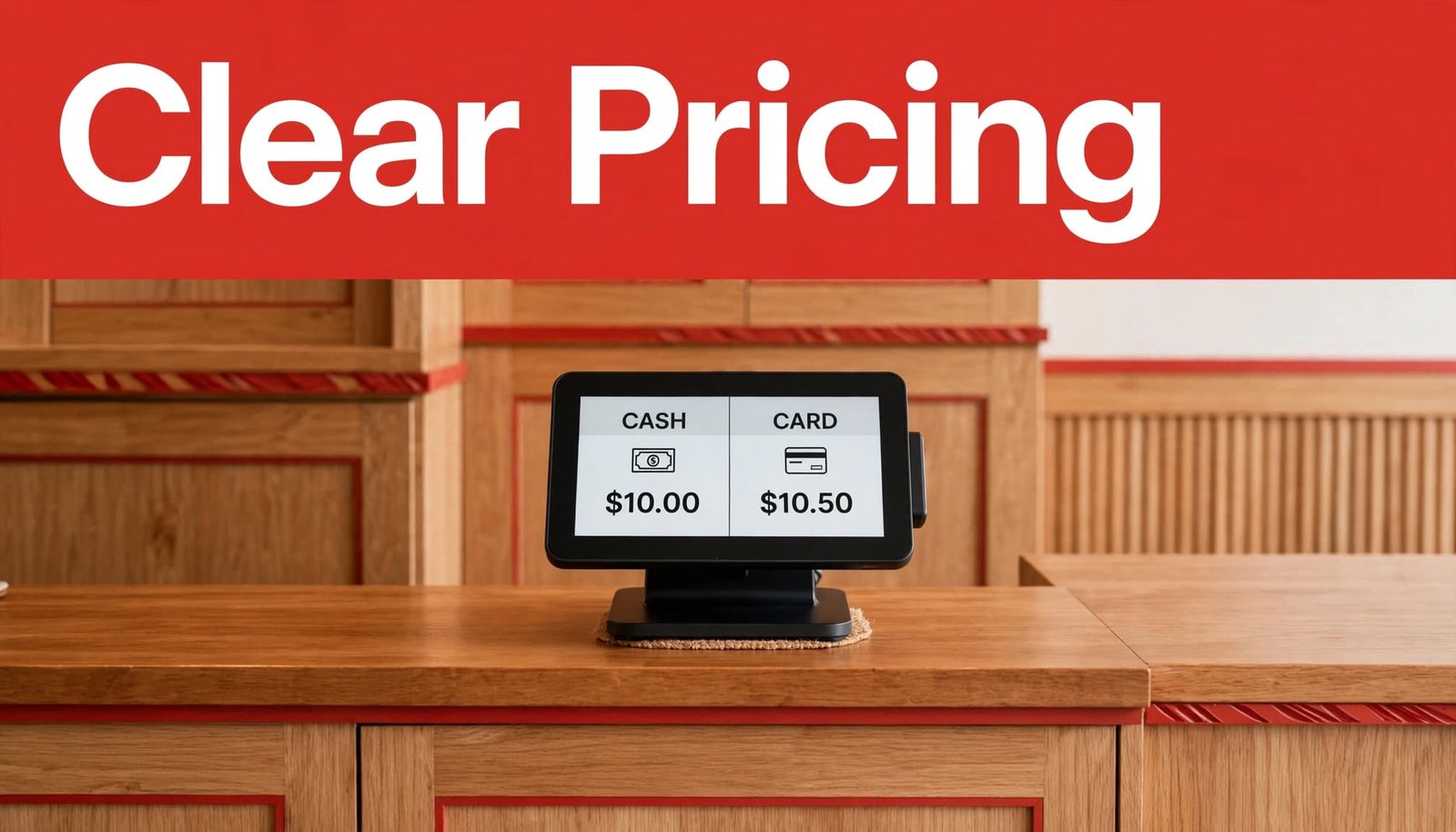
Providers sometimes use the terms interchangeably because both programs can reduce the amount paid by the business. Still, the customer-facing presentation can differ. The exact setup depends on the payment processor, POS software, terminal, card-network rules, state laws, and compliance requirements. Review how dual pricing works before choosing a format for your store.
Cash Discounts, Dual Pricing, and Credit Card Surcharges Are Not the Same
A credit card surcharge is generally an added charge for using a card. A cash discount reduces the posted price for cash or another permitted payment type. That distinction may sound minor, but it affects signage, receipts, processor configuration, and customer expectations.
Visa states that merchants using a credit card surcharge must follow its consumer disclosure requirements and product restrictions in its U.S. merchant surcharge guidance. State laws, provider policies, and network surcharging rules may also differ by program.
Get the program classification in writing before launch. Ask how your provider describes the model, which tenders, including debit cards, are included, and what receipt language and signage are required.
How the Customer Sees the Price at Checkout
Transparent pricing should show the cash amount, card amount, and reason for the difference before payment. In a restaurant, that may mean menu pricing and a customer-facing point of sale terminal. In retail, it may mean shelf labels, counter signage, and a receipt that matches the displayed amount.
Bars need the same clarity on tabs and printed checks. Food trucks need it on menus or ordering screens where customers can see it before tapping a card. Service businesses should show the pricing difference on estimates, invoices, deposits, and final receipts.
Online, phone, recurring, and manually keyed transactions may need a different setup. Don’t assume an in-person terminal configuration will carry over to every channel.
Fees, Savings, and Contract Terms to Review Before Signing
A lower advertised rate doesn’t reveal the full credit card processing fees in a cash discount or dual pricing program. Review processor markup, per-transaction charges, gateway fees, statement fees, PCI program fees, batch fees, equipment costs, software subscriptions, chargeback fees, monthly minimums, and setup or training charges. Treat labels such as zero fee processing as marketing language that still requires a complete fee review.
A credit card surcharge and a cash discount program may have different requirements, so the contract should match the model you’re evaluating. Ask the provider to explain how each fee affects your total processing costs.
Visa and Mastercard interchange schedules aren’t negotiated with the processor. Debit routing may also involve rules associated with the Durbin Amendment, depending on the transaction and account structure. The processor’s markup, fixed fees, equipment terms, gateway costs, and contract conditions may be negotiable. With interchange-plus pricing, ask the provider to separate interchange and network costs from its own markup.
Calculate your effective processing rate using the same statement period:
Total relevant payment fees / gross processed card volume x 100
That number gives a more useful view than a headline rate. A business processing $40,000 through 1,600 transactions will feel per-item charges differently than one processing the same volume through 500 larger checks. At 15 cents per transaction, 1,600 sales add $240 before percentage-based charges begin.

Questions to Ask About the Merchant Agreement
Request the full fee schedule and a written explanation for every recurring charge. Ask whether you’re entering a long term contract, how auto-renewal works, and what early termination charges apply. Also review equipment ownership, replacement costs, warranty coverage, required POS or gateway software, funding timing, reserve terms, support hours, refund handling, and exit procedures.
Ask whether the account is dedicated to your business or processed through an aggregate arrangement. Confirm whether you can export sales, menu, and customer data if you change providers later.
Compare at least three months of projected costs using your actual card volume, transaction count, average ticket, refund history, and sales channels. Tennessee merchant services and credit card processing should fit the way your business accepts payments, not force your business into a one-size-fits-all plan.
When the Program May Cost More Than It Saves
Savings can shrink when customers resist the price difference, staff apply it inconsistently, or refunds require manual corrections. Poor signage can create disputes. Expensive equipment or software can also erase early savings.
Businesses with many small transactions should pay close attention to per-item fees. Online sellers may face more gateway costs, fraud screening, and card-not-present expenses. Model your cash use, card mix, average ticket, customer behavior, and total monthly fees before making a decision.
A program that lowers processing costs but confuses customers can cost more through lost sales, refunds, and disputes.
Tennessee Requirements for Clear Disclosures and Consistent Checkout
This is general business information, not legal advice. Tennessee businesses should confirm current state laws, card-network surcharging rules, and processor policies before implementation. Review the program’s compliance requirements, since requirements can change and the correct setup may depend on the program structure and where payments are accepted.
Meet disclosure requirements with visible notices at the entrance, point of sale, menu, website, ordering page, and payment screen when applicable. A credit card surcharge should be identified clearly rather than presented as a discount. Show the amount or percentage difference and any checkout fee before payment, and ensure the receipt disclosure matches the displayed price.
Ask your payment processor whether its program supports required signage, receipt wording, terminal prompts, refunds, tips, split checks, and online orders. Confirm which tenders, including debit cards, are covered. A qualified Tennessee attorney or official state source can review a business-specific setup for legal compliance. For a broader example of how payment discounts are treated elsewhere, the California Department of Justice guidance distinguishes cash, check, and debit discounts from card surcharges. That guidance reinforces why a credit card surcharge can’t be treated as a cash discount, but California guidance isn’t a substitute for Tennessee review.
What to Put on Signs, Menus, Receipts, and Online Checkout Pages
Transparent pricing starts with a disclosure that shows the cash price, card price, or clearly explained difference, when the difference applies, accepted payment methods, and any limits or exceptions. Keep the language easy to read and place it before the customer commits to payment.
Use the same information across printed menus, shelf tags, counter notices, online ordering pages, invoices, and customer-facing displays. Hidden notices, tiny print, or a price change that appears only after authorization can lead to complaints and chargebacks.
Rules for Restaurants, Bars, Retailers, and Service Businesses
Restaurants and bars should test tips, adjusted tips, split checks, tabs, refunds, and printed receipts. Retailers should test returns, exchanges, discounts, gift cards, and regulated products before turning on a new pricing model.
Food trucks and mobile sellers should test contactless payments and weak internet connectivity. Service businesses should show the difference on estimates, deposits, invoices, and final receipts. Online and phone sales need separate approval and testing instead of copying an in-person setup.
Before launch, document the setup and confirm the remaining compliance requirements. Test each payment path to protect the customer experience and identify problems before customers encounter them.
How to Choose and Launch a Cash Discount Program Without Confusing Customers
Start with your real payment data: monthly card volume, transaction count, average ticket, card-present and card-not-present sales, refunds, tips, and current processing costs. Give the same information to every provider so each proposal reflects the same operating conditions. Compare a cash discount program with dual pricing and a credit card surcharge before choosing a configuration.
Before signing, ask for a written demonstration of cash and card pricing, receipts, voids, refunds, tips, split payments, offline procedures, and reports in your point of sale system. If Clover POS is under consideration, include its configuration and testing in the review. Treat claims of zero fee processing as marketing language until you review every fee. Confirm compliance requirements and choose EMV-capable terminals and contactless acceptance where they fit your business. Use role-based staff logins, follow payment card industry security practices, and limit access to price changes, refunds, voids, and tax settings.
Train employees to explain the pricing calmly and protect the customer experience. They should be able to point out the posted prices without pressuring anyone to pay a certain way.
Test the Entire Payment Flow Before Going Live
Run a cash sale, chip-card sale, contactless sale, mobile wallet payment, refund, partial refund, void, tip adjustment, split check, gift card sale, online order, and manually entered transaction. If your system supports offline processing, test that too.
Confirm that the customer receipt, POS report, merchant statement, and bank deposit show the correct amounts. Verify who pays the difference when a transaction is refunded or partially refunded. This step matters most during busy service periods, when staff need the system to work without guesswork.
Track Results Month Over Month Instead of Guessing
Use a simple monthly worksheet for gross card volume, cash volume, transaction count, refunds, chargebacks, total processing fees, software and equipment costs, customer complaints, and net deposits.
One month can be noisy. Three months can show whether the program is reducing costs without creating customer friction. Compare your effective rate and total cost before and after launch, then request written clarification for unexplained fee changes.
Frequently Asked Questions
Can a small business in Tennessee use cash discounting?
A small business may use a cash discount program, but eligibility depends on the business model, payment channels, state laws, and compliance requirements. Treatment of debit cards must also be confirmed rather than assumed.
Get written approval before launch, then review customer-facing disclosures and the transaction flow.
Is dual pricing better than a cash discount?
Neither option is automatically better. With dual pricing, customers should see the cash price and card price clearly before completing payment.
The right choice depends on how your POS presents prices, which customers use, and what you want to accomplish. Compare the full customer experience and payment workflow, not only projected savings.
Can a business apply the program to online or phone orders?
Card-not-present payments may require different rules, checkout disclosures, gateway settings, and approval from your payment processor. Don’t copy an in-person setup into an online store or phone-order process without testing it and receiving written guidance.
Online sellers should also review access controls, transaction screening, and payment-page security.
What happens if a customer disputes the price difference?
Keep dated copies of signs, menus, invoices, receipts, checkout screens, transaction records, and staff training materials. These records support legal compliance for a credit card surcharge or discount program, but they don’t guarantee the outcome of a dispute.
Respond by the processor’s deadline and request transaction-level evidence when the claim is unclear.
Which fees can a business negotiate with its processor?
Processor markup, per-item fees, monthly charges, equipment terms, gateway costs, and contract conditions may be negotiable. Visa and Mastercard interchange schedules generally aren’t negotiated through the processor.
Compare written proposals using your own sales volume and transaction count. A low rate is only useful when the complete fee schedule and contract terms support it.
Clear Pricing Builds Better Payment Decisions
Cash discounting and dual pricing are payment strategies, not shortcuts around customer communication or contract review. Identify the model, confirm Tennessee and network compliance requirements, verify legal compliance, disclose prices before payment, review processing costs, test the POS workflow, train staff, and monitor results for at least three months.
Ask a Tennessee merchant services provider for a written proposal that explains pricing, equipment, customer disclosures, support, and cancellation terms. Transparent pricing protects the customer experience while giving your business a clearer view of its real payment costs.