
A payment gateway securely collects your customer’s payment details, encrypts them, and sends them for processing at checkout. It helps your business accept online payments while protecting sensitive information.
Customers expect convenient card acceptance, even for small purchases. The Federal Reserve reports that cash use for purchases under $25 has fallen by more than half since 2016. Understanding how a payment gateway works helps you make decisions about security, costs, and cash flow.
Payment Gateway vs. Processor: Who Does What?
Several services work together to complete a payment, although one provider may bundle them.
| Service | Main responsibility |
|---|---|
| Payment gateway | Collects and securely transmits payment data. |
| Payment processor | Handles transaction messages and coordinates funds movement between banks through card networks. |
| Merchant account | Provides the arrangement through which your business accepts and settles card payments. |
Online card acceptance needs a gateway and a merchant-account arrangement. Some payment service providers bundle these through aggregated accounts, so you don’t necessarily apply for a separate dedicated merchant account.
A physical store using only a card terminal may not need a separate gateway. Our merchant accounts and processing overview explains how these arrangements support different sales channels.
How a Payment Gateway Processes a Transaction
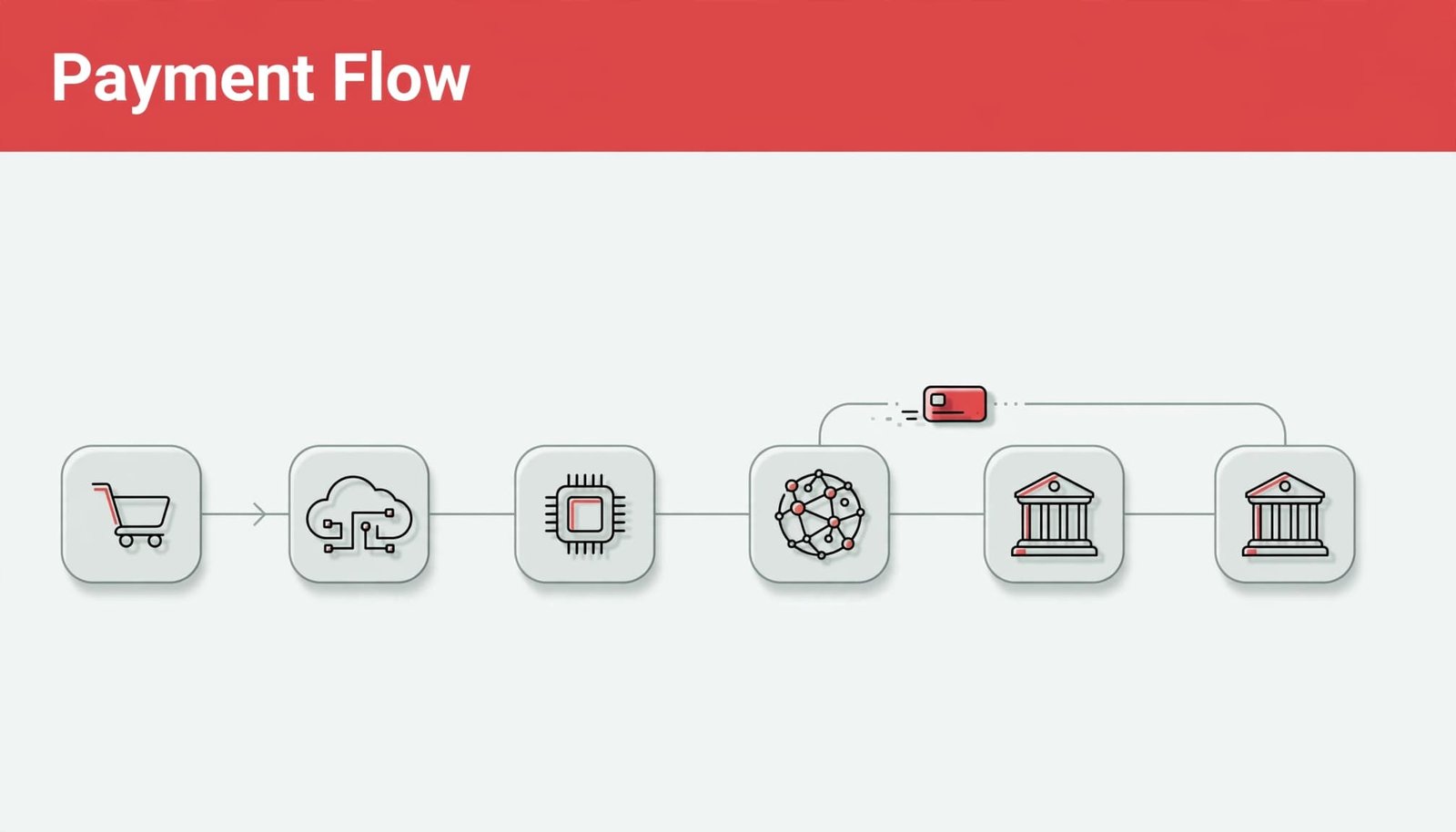
Checkout and Authorization
Authorization establishes whether the customer’s bank will approve the payment.
- Your customer enters card details or selects a supported digital wallet.
- The gateway encrypts the payment information and transmits it to the acquiring bank or processor.
- The payment processor routes the request through the card network, such as Visa or Mastercard, to the issuing bank.
- The issuing bank checks available funds or credit and fraud indicators. Its approval or decline returns through the same chain, usually within seconds.
The issuing bank is the customer’s bank. The acquiring bank supports the merchant’s card acceptance.
Capture, Settlement, and Your Deposit
After approval, your business captures the payment, immediately or later when an order ships. Captured transactions are submitted for settlement, often in a daily batch.
Settlement transfers funds between the financial institutions. Your provider then pays your business according to its funding schedule.
Card settlement commonly takes one to three business days. Descriptions of 24- or 48-hour funding reflect particular schedules; batch cutoffs, weekends, holidays, and account terms affect when funds become available.
Gateway Types and Their Checkout Tradeoffs
A hosted gateway can redirect customers to a provider’s payment page, such as PayPal. This hosted approach generally requires less development and limits your handling of card data, but customers leave your checkout page. Assess whether a redirect fits your checkout experience. Added steps may create friction that contributes to cart abandonment for some customers.
On-site checkout with off-site processing keeps customers on your website while provider-hosted fields collect sensitive information. This balances checkout consistency with reduced direct exposure to card data.
On-site or self-hosted payments route payment information through your own infrastructure. API-based integrations offer more customization, but handling raw card details increases security responsibilities.
For a small business without dedicated developers, choosing a payment gateway with hosted checkout is usually the more manageable starting point. Custom integration makes sense when your checkout requirements justify ongoing development and maintenance.
Payment Gateway Fees: A Simple Transaction Example
Gateway pricing can include setup charges, monthly subscriptions, and per-transaction fees. Combined card-processing costs commonly range from 2.5% to 3.5%, though fixed charges and transaction details affect the effective rate.
At a bundled rate of 2.9% plus $0.30, a $100 sale costs $3.20. That leaves $96.80 before other business expenses or account charges.
Gateway-only pricing is different. Authorize.net’s published Gateway Only plan lists $25 monthly, $0.10 per transaction, and a $0.10 daily batch fee. Those charges don’t replace separate processing costs.
Contracts may also include PCI compliance charges and chargeback fees, commonly $15 to $50 per dispute. Compare transaction fees and total monthly costs across options, including providers such as Stripe. Use your expected sales volume and average ticket size, not the lowest advertised rate.
Security and Integration That Support Your Business
Protect Customer Information
PCI DSS requirements govern the protection of payment account data during storage, processing, and transmission. Gateways that handle card data must comply, while your business has responsibilities for customer data based on its payment environment.
Look for TLS encryption, often called SSL, and tokenization, which replaces card numbers with substitute identifiers. 3D Secure supports customer authentication. Address Verification Service (AVS), CVV checks, and fraud detection tools and monitoring can help assess suspicious payments.
Never retain card security codes after authorization.
Choose Integration and Support That Fit
Prioritize compatibility with your existing store and processor. Shopify and Magento support provider integrations, while an API integration enables custom builds. QuickBooks connections can help reconcile payments, fees, and deposits.
For Shopify, activate a supported provider under Payments, connect the account, configure payment options, and test successful payments, declines, and refunds before launch.
If you need recurring billing, confirm that both the provider and its integration support it.
Compare total fees, funding schedules, contract length, cancellation terms, and support availability. These operational details directly affect your daily workload.
Payment Gateway FAQs
Which Payment Methods Can a Gateway Support?
Depending on the provider, options include credit and debit cards, Apple Pay, Google Pay, PayPal, Venmo, ACH, and bank transfers. Choose methods your customers use; one integration doesn’t automatically include every option.
What Matters When Selling Internationally?
Country eligibility, local payment methods, multi-currency support, currency-conversion charges, and settlement currencies all matter. Displaying prices in another currency doesn’t automatically mean your business can receive deposits in that currency.
Key Takeaways for Your Business
A payment gateway protects and transmits checkout information. The processor, card networks, and banks handle authorization and the financial steps that follow.
Choose a solution around your checkout, complete costs, and funding needs. Our steps for accepting credit cards can help you turn those requirements into a practical payment setup.