
Interchange plus pricing separates your card-processing bill into interchange, card-network fees, and the processor’s markup. That visibility helps you compare quotes, negotiate provider charges, and understand why one transaction costs more than another.
For your business, the most important number is the total cost, including monthly fees and equipment expenses. A low advertised markup doesn’t automatically deliver a lower bill.
Start with the three components, then put them together using transaction and monthly examples.
How interchange plus pricing separates your fees
Every card payment involves several parties, and your processing fee doesn’t all go to the company handling your account.
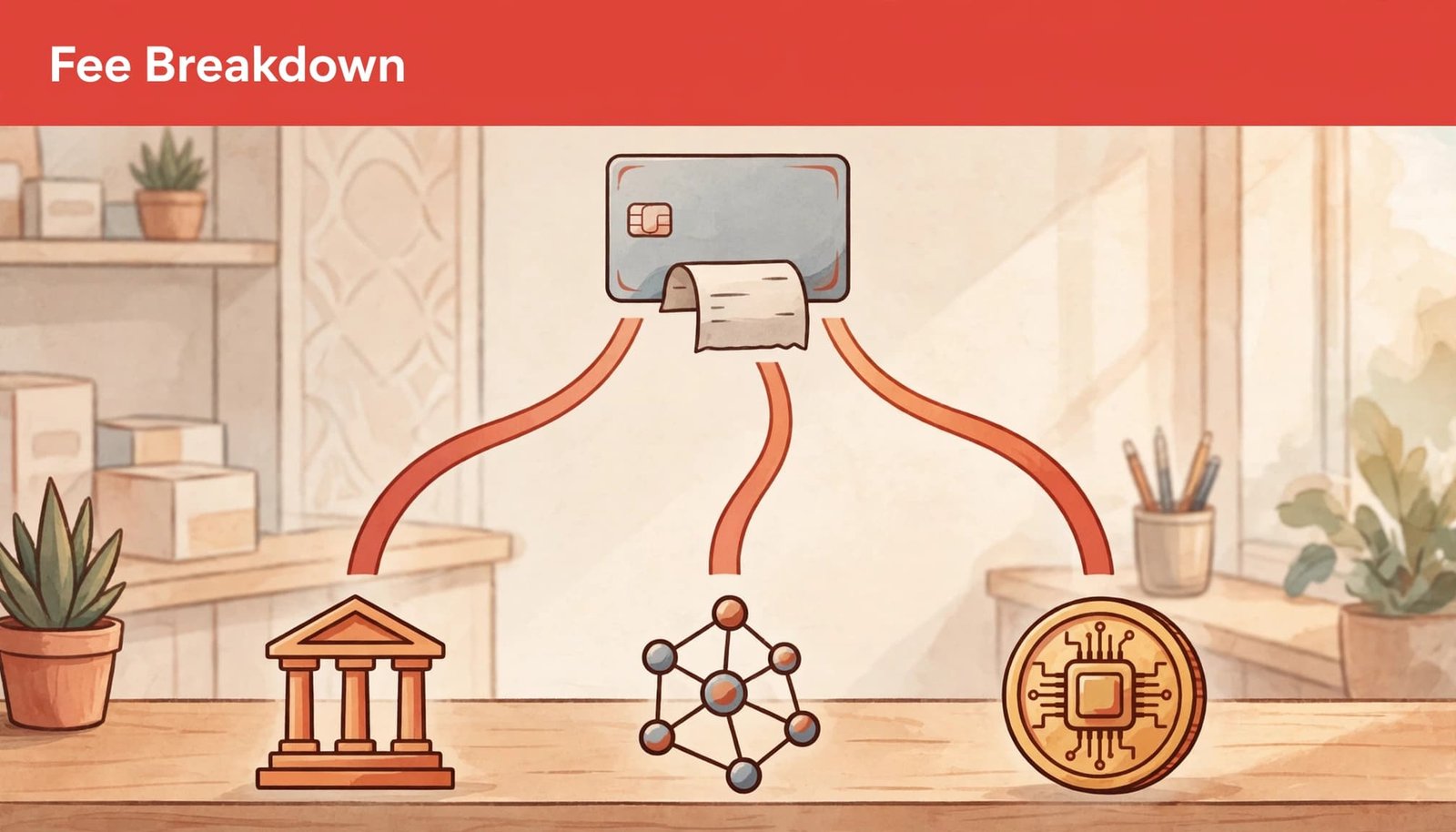
Interchange and network fees are pass-through costs
Interchange generally goes to the bank that issued your customer’s card. Visa and Mastercard publish a pricing schedule with interchange rate categories based on card product, business type, and transaction details.
Card network fees go to card brands for network services. They include percentage-based assessments and certain per-item charges.
As of 2026, Visa’s credit-sales assessment is 0.14%, as outlined in this network assessment fee breakdown. Its domestic credit Acquirer Processing Fee, or APF, is $0.0195 per authorization.
These are separate charges, and other network fees can also apply. Processors generally pass them through rather than negotiate the underlying schedules.
The processor adds its own markup
The payment processor’s markup pays for its payment-processing services. It’s commonly expressed as a percentage plus a per-transaction fee, such as interchange + 0.30% + $0.10.
Another quote might read interchange + 0.40% + $0.08. Neither figure includes the underlying interchange or network costs.
This markup is generally negotiable. Our merchant account setup guide explains how the account relationship supports payment acceptance.
What a $100 transaction actually costs
A markup of 0.30% + $0.10 adds $0.40 to a $100 sale. Interchange and network charges are added separately.
For a concrete calculation, use the 2.04% + $0.10 spend-qualified Visa Infinite category in Visa’s published interchange schedule. The transaction must meet that category’s qualification requirements.
Here’s the calculation for one $100 sale with one authorization:
| Fee component | Calculation | Cost |
|---|---|---|
| Interchange | $100 × 2.04% + $0.10 | $2.14 |
| Visa credit assessment | $100 × 0.14% | $0.14 |
| Visa credit APF | One authorization | $0.0195 |
| Processor markup | $100 × 0.30% + $0.10 | $0.40 |
| Total shown | All four charges | $2.6995 |
The charges shown total approximately $2.70. Actual billing can aggregate fractional cents across transactions, and additional applicable network or account charges would increase the total.
A quote of interchange + 0.30% + $0.10 describes the processor’s margin, not your complete processing rate.
This distinction helps you recognize the difference between an attractive markup and an affordable overall agreement.
Why card type and transaction details change costs
Interchange plus pricing passes underlying cost differences through to your business. Understanding those differences helps explain monthly changes without assuming your processor increased its markup.
Debit and rewards cards have different economics
Debit card transactions usually cost less than premium rewards credit cards. Eligible U.S. regulated debit transactions generally have an interchange rate of 0.05% + $0.21, with an additional $0.01 fraud-prevention adjustment where applicable.
On a $100 payment, that’s $0.26 or $0.27 before network charges and processor markup. It contrasts with the $2.14 interchange charge in the Visa Infinite example.
Unregulated debit has different schedules. Expensive rewards cards, commercial cards, and some American Express transactions can also carry higher underlying acceptance costs. American Express uses a different fee structure, so its charges don’t always match Visa or Mastercard terminology.
Payment method and qualification also matter
A chip or contactless payment at your counter can qualify differently than an online purchase or manually entered card number. Card-not-present transactions often carry higher costs because their risk and processing requirements differ.
Your merchant category, transaction data, settlement timing, and domestic or international card status also affect applicable charges.
Accurate transaction data and timely settlement support proper qualification. Your POS system and payment gateway therefore influence more than checkout convenience; their configuration can affect the fees your transactions receive.
Interchange plus vs. flat-rate pricing
A flat rate bundles underlying card costs and processor margin into one advertised transaction price. An illustrative rate is 2.9% + $0.30.
Within the same payment channel, that rate generally stays consistent across eligible card types. Providers may still charge different rates for in-person, online, and keyed payments.
Predictable pricing can include a cushion
A flat-rate processor builds a cushion into its pricing to absorb variation between cheaper and more expensive cards. Your transaction charge is easier to predict, but the bundled rate hides the processor’s actual margin.
That makes it harder to compare provider markups directly. You may pay the same advertised rate for an inexpensive debit transaction and a premium credit transaction.
Flat-rate pricing also doesn’t necessarily include software or account-service monthly fees, hardware, chargebacks, or other costs. Predictable transaction pricing and an all-inclusive business expense are different things.
Volume matters, but there’s no universal cutoff
You’ll often see $10,000 to $50,000 in monthly processing volume suggested as a starting point for considering interchange plus. That range isn’t an eligibility rule or a guaranteed savings threshold.
Average ticket size, transaction count, card mix, and fixed fees determine the outcome. Interchange plus can work below that range, while an expensive agreement can disappoint above it.
High-volume businesses with multiple locations should compare negotiated offers under both models. Add location-specific account, gateway, and software fees before deciding which arrangement supports efficient operations.
Read your statement and calculate the effective rate
A useful interchange-plus statement separates interchange, network charges, and processor markup. Labels vary, so markup may appear as a discount fee, margin, basis-point charge, or per-item fee.

For calculation purposes, consider $20,000 in monthly card sales across 400 transactions, with the following assumed charges:
| Statement component | Monthly amount |
|---|---|
| Interchange | $350 |
| Network fees | $40 |
| Processor percentage, 0.30% | $60 |
| Processor transaction fees, 400 × $0.10 | $40 |
| Monthly account fee | $20 |
| Total processing fees | $510 |
These figures illustrate the calculation, not a promised rate or an actual merchant statement.
Your effective processing rate is total processing fees ÷ matching card sales × 100. Here, $510 ÷ $20,000 × 100 equals 2.55%.
Use the same reporting period and sales definition each month. Reconcile refunds and funding delays rather than dividing fees by whatever deposits reached your bank account.
Include monthly fees in your review, along with processing-related gateway, PCI, batch, statement, minimum, and chargeback charges. Track equipment and software separately, then add them when comparing total ownership costs. An unfamiliar fee isn’t automatically improper; check an unusual card category against the relevant pricing schedule and transaction details before treating the charge as improper.
Compare processor quotes using the same sales
Apply competing proposals to the same transaction history. Comparing an in-person rate against an online rate, or a markup against an all-in total, produces misleading results.
At 2.9% + $0.30, the same $20,000 and 400 transactions would cost $700 before any separate charges. That’s $190 more than the $510 illustration above.
The difference depends on the assumed interchange and network costs. A different card mix changes the result.
Use these steps to make each proposal comparable:
- Apply each quote to three months of matching sales, transaction counts, and payment channels.
- Separate interchange and network pass-throughs from percentage markup, per-item markup, and authorization charges.
- Add monthly minimums, PCI, gateway, batch, software, equipment, and account fees.
- Review contract length, renewal terms, cancellation charges, equipment ownership, and price-change provisions.
Don’t assume every authorization creates the same charge. Declines, retries, refunds, and additional authorization requests can receive different treatment under the fee schedule.
Our Tennessee credit card processing tips also emphasize matching pricing to ticket size and payment channel. That approach helps keep operational convenience and total expense in balance.
Key takeaways for comparing markups
Both parts of the markup matter. On $20,000 and 400 transactions, 0.30% + $0.10 costs $100, while 0.40% + $0.08 costs $112.
At the same volume across 2,000 smaller transactions, those markups become $260 and $240. The offer with the higher percentage now has the lower markup total.
Average ticket size can change which proposal wins, even before account fees enter the comparison.
Frequently asked questions
Is interchange plus pricing always cheaper?
No. High markups, monthly minimums, gateway charges, or other recurring expenses can outweigh savings on underlying card costs. Compare total monthly expense using your transaction mix rather than assuming transparency guarantees a lower price.
Interchange-plus pricing defines how transaction costs are presented. It doesn’t automatically define the rest of your agreement.
Can I negotiate both parts of the markup?
Yes. The processor’s percentage and per-transaction fee are generally negotiable, along with certain account charges, equipment terms, and contract conditions. Visa and Mastercard interchange schedules aren’t negotiated through your processor.
A 0.30% markup is also called 30 basis points. One basis point equals 0.01 percentage point.
Does interchange plus require minimum volume or a long contract?
No. Those are provider-specific terms. Helcim, for example, publishes interchange-plus pricing without monthly minimums or long-term contracts.
Other agreements can include minimums, recurring fees, or cancellation provisions. The pricing model alone doesn’t establish those conditions, which is why they belong in your quote comparison.
Make the complete bill your pricing benchmark
Interchange plus pricing gives you a clearer view of where processing dollars go. Its strongest advantage is the ability to separate card costs from the charges your provider controls.
Compare the complete monthly expense using matching sales, transaction counts, and contract terms. With that foundation, you can negotiate more effectively and choose payment processing that supports your business without unnecessary expense.