
An acquiring bank is the financial institution that enables your business to accept credit and debit card payments, exchanges funds with card issuers, and coordinates the final transfer between banks. It’s the banking connection behind your merchant account.
You may work with a payment provider rather than the bank itself, which can make these responsibilities confusing. Understanding who handles each part helps you compare services, manage costs, and protect your cash flow.
Key Takeaways
- The acquirer supports the merchant, while the issuing bank supports the cardholder.
- Your processor handles transaction technology, although providers often bundle several roles.
- Authorization approves a payment; clearing and funds transfer move the money.
What does an acquiring bank do?
An acquiring bank, also called a merchant acquirer, connects merchants to a card network such as Visa, Mastercard, Discover, China UnionPay, or American Express, depending on its network agreements. This connection lets businesses accept card payments.
It establishes or sponsors the merchant-account arrangement and exchanges payment funds with issuing banks through the card network. This arrangement lets merchants process card payments. Your merchant account is separate from your everyday operating account. Our explanation of how merchant accounts work covers that distinction.
Acquirers need applicable financial-regulatory authorization and card-scheme approval. These obligations include financial, operational, and security requirements, such as those established in Visa’s card-network rules.
Acquiring bank vs. issuing bank vs. processor
Several organizations help complete a card payment, but each has a different responsibility.
| Participant | Main responsibility |
|---|---|
| Acquiring bank | Supports the merchant, manages acquiring risk, and meets its obligations for transferring cleared funds. |
| Issuing bank | Provides the customer’s card and approves or declines authorization requests. |
| Payment processor | Transmits transaction messages and operates processing technology. |
| Card network | Routes messages and establishes rules connecting issuers and acquirers. |
One provider may perform several functions, but processing technology and acquiring responsibility remain distinct.
A payment gateway securely collects and transmits checkout data. An independent sales organization, or ISO, enrolls merchants on behalf of an acquirer or processor; the underlying banking relationship remains with the acquirer.
A payment service provider can bundle checkout, payment processing, and aggregated merchant-account access. That’s why you may receive support, statements, and deposits under your provider’s brand without interacting directly with the acquiring bank.
How a card payment reaches your business
Consider a customer using a Chase-issued Visa at a retailer whose acquiring bank is Bank of America.
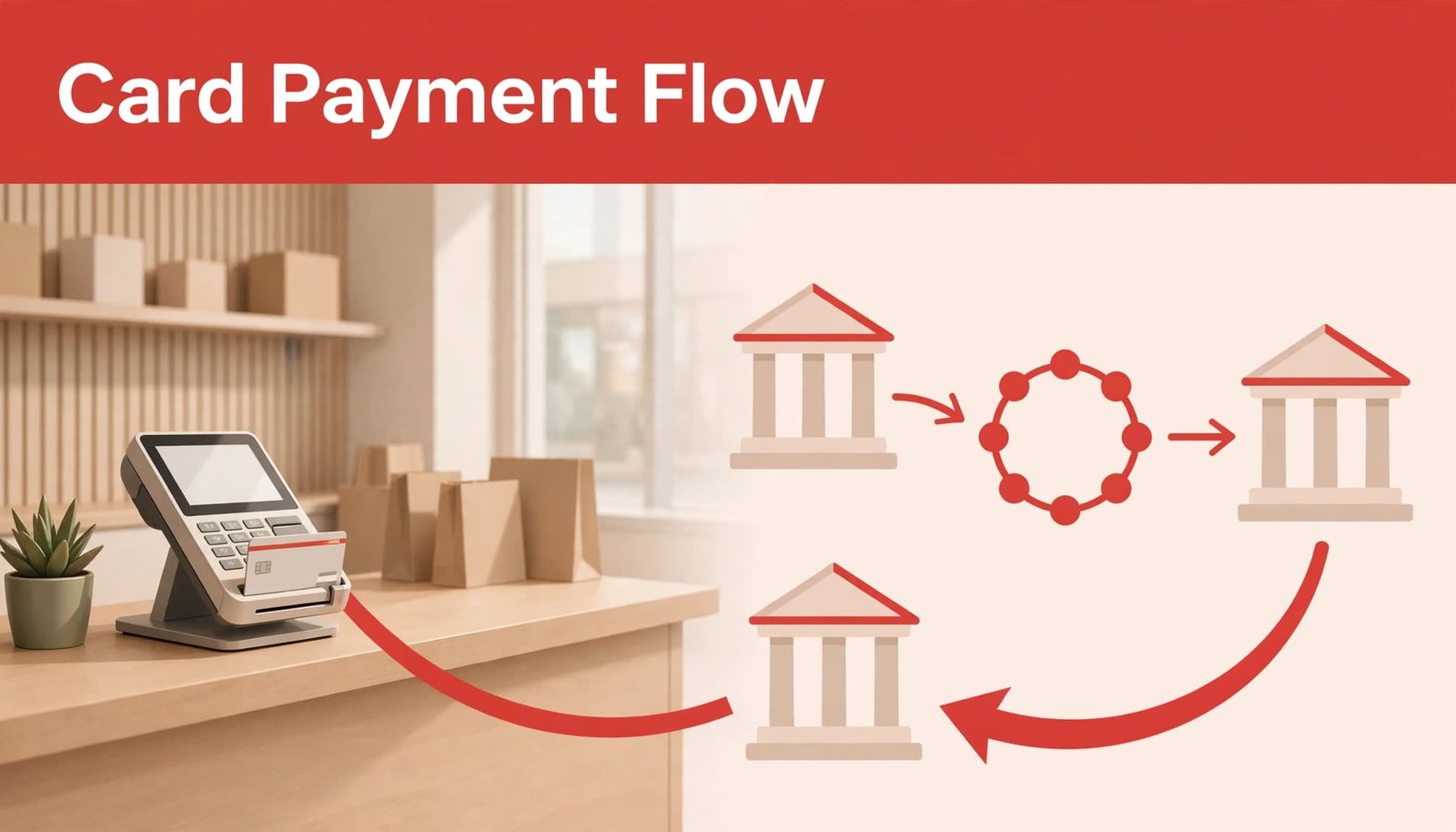
The transaction follows this sequence:
- The retailer’s terminal or gateway captures the payment information and sends it through the processor to the acquirer.
- The authorization request travels through Visa to Chase, the issuing bank.
- Chase evaluates the account and fraud indicators, then returns an approval or decline through the same connections. Declined transactions don’t proceed to capture or payout.
- After capture, transaction details enter clearing. Settlement exchanges the financial obligations between the issuer and acquirer.
- The merchant receives its payout according to the funding agreement, adjusted for applicable fees, refunds, reversals, or reserves.
Banking with Bank of America alone wouldn’t make it the retailer’s acquirer; it must provide that acquiring relationship.
Authorization isn’t a deposit. An approved transaction still needs capture and interbank funds exchange before merchant payout.
What merchants pay for acquiring
Your processing bill covers several participants, so your merchant acquirer doesn’t keep every dollar charged.
Understanding the merchant discount rate
The merchant discount rate generally combines interchange fees paid to the issuer, network assessments, acquirer fees, and processor markup. It’s commonly expressed as a percentage plus an optional fixed transaction fee.
A frequently quoted range is 1% to 3%, equivalent to $1 to $3 on a $100 sale before any separate fixed fee. It’s not a universal ceiling; card type, sales channel, and business risk affect pricing.
Blended pricing bundles costs into one rate. Interchange-plus separates interchange from markup; interchange-plus-plus usually separates network fees as well. Providers use these labels differently.
Understanding your settlement method
With net settlement, fees are deducted before payout. Gross payouts deliver transaction proceeds before processing fees are collected separately.
With this method, your daily balance reflects reversals, refunds, interchange, and acquiring charges, subject to contract terms. Deposit timing is separate from authorization speed, as our credit card payout guide explains.
Why acquiring banks monitor merchant risk
Acquirers face exposure when payments are reversed after merchants receive funds. Three situations explain that risk: a merchant voluntarily issues a refund, an authorized payment is reversed before the interbank exchange of funds, or a cardholder disputes a transaction through the issuing bank, creating a chargeback.
A chargeback rate above 1% is a warning sign, not a universal network threshold. Visa and Mastercard use program-specific calculations, transaction counts, and regional criteria. Excessive activity can lead to assessments against acquirers and restrictions on merchant accounts.
Visa’s Acquirer Monitoring Program, effective April 1, 2025, consolidated several fraud and dispute programs.
Acquirers also require applicable PCI DSS compliance. Security failures can bring remediation expenses, contractual liability for losses, and card-brand assessments. Clear refund policies, recognizable billing descriptions, and secure payment systems help protect customer trust and business revenue.
Frequently Asked Questions
Which companies provide acquiring and processing services?
JPMorgan Chase, Bank of America, Wells Fargo, and HSBC offer merchant services in relevant markets. Elavon, Fiserv, Worldpay, and Global Payments provide acquiring or processing services; FIS supplies financial technology. Their exact roles depend on the arrangement.
How should I compare acquiring arrangements?
Compare total fees, funding schedules, reserve provisions, dispute support, and cancellation terms in the merchant account contract. Underwriting commonly examines your business model, processing history, and financial exposure.
For cross-border transactions, local acquiring may improve the authorization rate and reduce cross-border costs. Visa and Mastercard publish provider directories that help businesses identify available acquiring partners.
Make your acquiring relationship work for your business
Your acquiring bank connects card acceptance with interbank funds movement and merchant payouts, and takes responsibility for the merchant side of the transaction. Your processor and service provider make that connection accessible through everyday payment tools and support.
Understanding these roles gives you greater control over processing decisions. Compare the complete agreement, not only the advertised rate, so your payment setup supports dependable cash flow.