
PIN debit routing sends a debit-card payment through an eligible debit network for authorization and settlement. Your payment processor may use smart routing, rules for selecting among supported, eligible networks. Those rules help determine the transaction’s path and cost, and whether an alternative is available during an outage.
For your business, the opportunity is lower acceptance costs without unnecessary checkout friction. Stripe reports that debit cards accounted for 30% of US consumer payments in 2024, so even small routing differences deserve attention.
Understanding the payment path helps you connect terminal settings with the charges on your statement.
Key Takeaways
Routing savings depend on eligible networks, processor support, and pricing that passes lower costs through to you. PINless debit can support online payments, but availability varies. Lower fees also need to be weighed against approval rates, fraud exposure, dispute rules, and funding schedules.
PIN, PINless, and Signature Debit Compared
A debit card can access different payment networks, even though every transaction draws against the customer’s bank account.
The main differences are authentication and the available routing path.
| Payment type | Customer authentication | Typical routing |
|---|---|---|
| PIN debit | Customer enters a PIN | Eligible domestic debit network |
| PINless debit | No PIN entry | Eligible domestic debit network |
| Signature debit | No PIN, usually no physical signature required | Visa or Mastercard debit rails |
“Signature debit” is a routing category, not a promise that your customer will sign a receipt. Visa and Mastercard each provide debit rails for their branded cards. Choosing credit on a debit-card terminal doesn’t turn the purchase into borrowed money.
Regional debit networks, also called back-of-card networks, include NYCE, SHAZAM, Accel, STAR, and PULSE. A Federal Reserve-hosted network submission identifies these domestic networks.
Debit’s scale is substantial: Redbridge cites 72.7 billion US non-prepaid debit transactions in 2018.
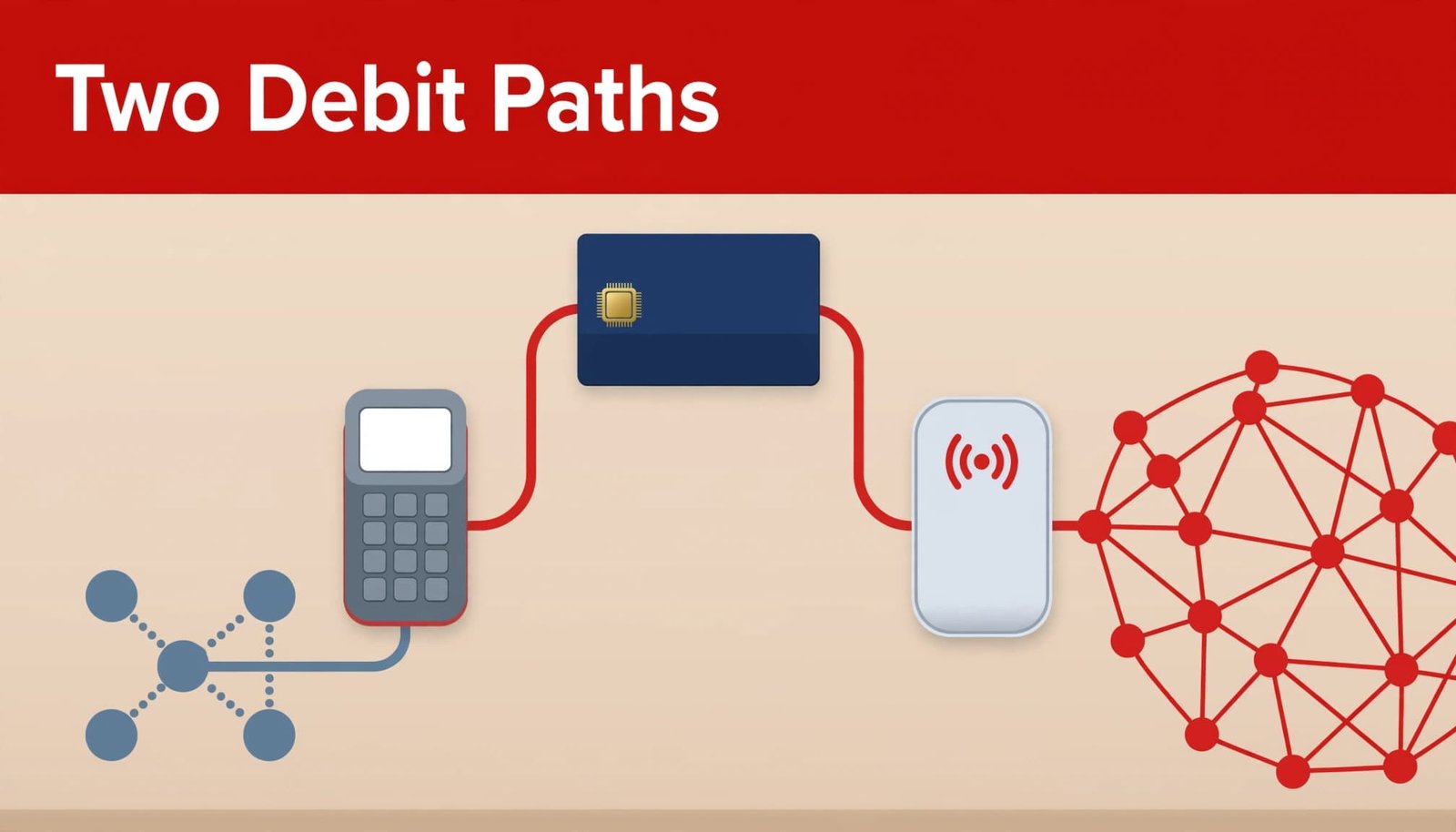
How PIN Debit Routing Moves a Payment
Several systems work together between the customer’s card presentation and your bank deposit.
- The customer presents the card. Your terminal reads the chip, contactless credential, or other supported payment information. For PIN debit, the customer enters their PIN through an approved, encrypted PIN pad.
- The processor identifies eligible routes. Card information, transaction characteristics, and merchant settings determine which networks can carry the payment. Least-cost routing compares supported options rather than selecting any network indiscriminately.
- The selected network requests authorization. Your processor or acquiring bank sends the transaction through that network to the issuing bank. The issuer evaluates authentication, available funds, account status, and fraud controls before approving or declining.
- The payment settles and funding follows. The network calculates participating institutions’ payment obligations. Your acquirer or processor then funds your merchant account according to your agreement.
Many PIN debit transactions use a single-message system that combines authorization and financial transaction information. Signature debit commonly separates authorization from later clearing.
Your POS receipt confirms the checkout result; transaction reporting reveals the network and associated cost.
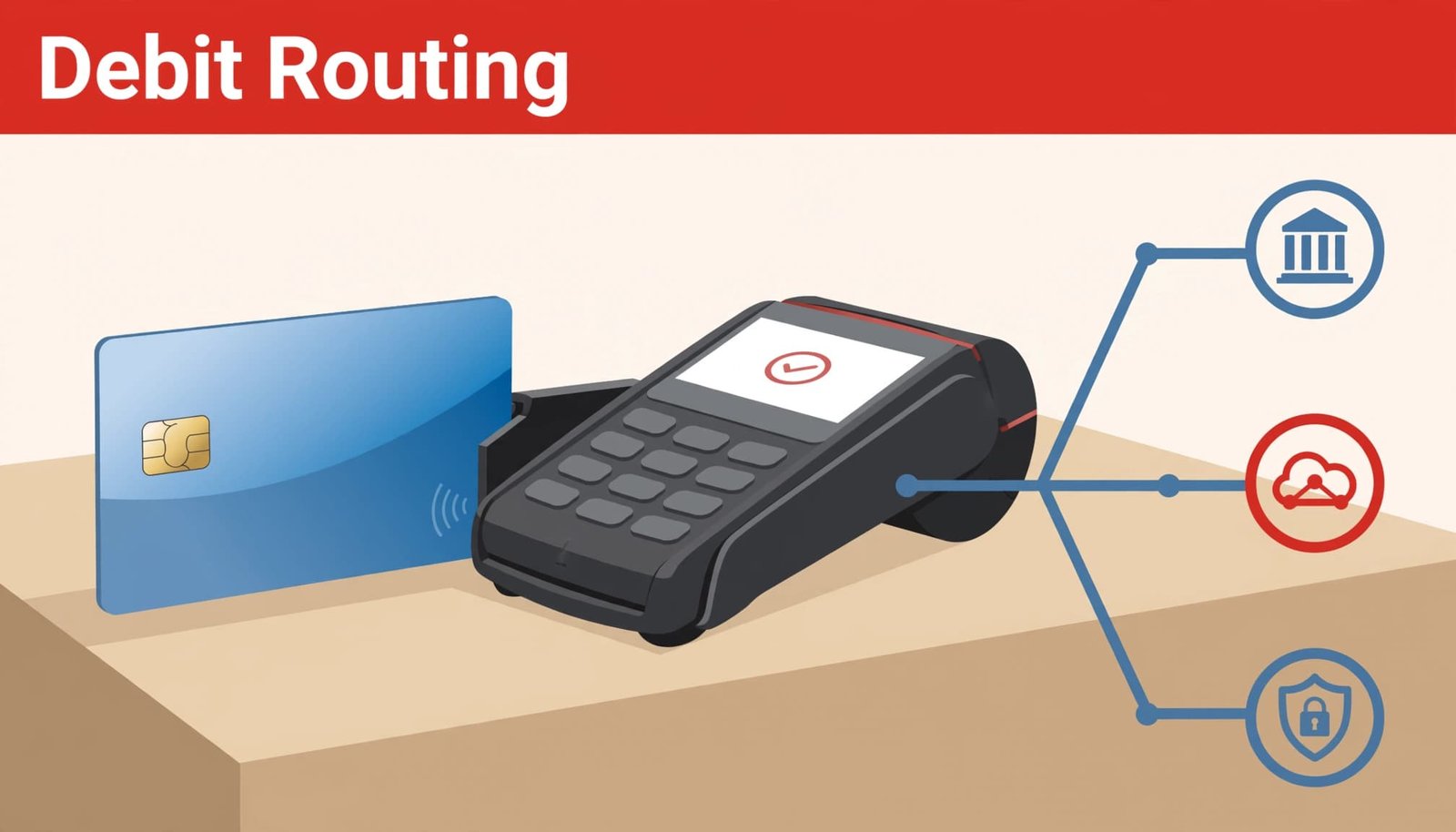
What Determines Which Networks Are Available?
Card and Merchant Eligibility
The Durbin Amendment, enacted in 2010, established debit-routing protections implemented through Regulation II. Debit cards must support at least two unaffiliated networks, and the routing requirement also covers card-not-present transactions.
That doesn’t mean every transaction can use every network. The card’s bank identification number, or BIN, helps determine BIN eligibility. The issuer, card product, network participation, and transaction type also affect which routes are available.
For a card-not-present purchase, network participation, transaction type, your merchant category code, and processor support can affect PINless availability. Your processor must evaluate eligibility before attempting a particular route. A network logo alone doesn’t establish that an online or PINless transaction qualifies.
Terminal, Gateway, and Wallet Support
Your terminal application, gateway, and acquiring connection must support the selected network. Compatible hardware alone isn’t enough; software configuration and processor certification also matter.
Our guide to chip and PIN readers explains equipment considerations.
Contactless cards and mobile wallets add another layer. Their payment credentials and authentication methods can limit routing options. Apple Pay or Google Pay support doesn’t automatically mean domestic debit routing is enabled for those transactions.
How Routing Changes Merchant Costs
Interchange Is Only Part of the Bill
The published Regulation II interchange framework caps covered-issuer debit interchange fees at $0.21 plus five basis points, or 0.05%, with an additional $0.01 fraud-prevention adjustment where applicable. The asset threshold generally separates issuers above $10 billion from exempt smaller issuers.
On a $100 payment, that formula produces $0.26 or $0.27 in interchange before other charges. It isn’t an all-in processing rate, and it isn’t exclusive to PIN transactions.
Redbridge separates merchant expenses into four categories: interchange, network assessments, acquiring fees, and miscellaneous fees. It also argues that signature-route network assessments have widened, making total network cost important.
Your Pricing Model Controls the Benefit
Interchange-plus pricing passes underlying cost differences through while separately identifying processor markup. POSNexus emphasizes that routing savings generally stay with the processor under unchanged flat-rate or tiered pricing.
Our explanation of hidden merchant services costs helps separate those charges.
Redbridge estimates that an unfavorable terminal selection can add about 14 basis points in some situations. On $100, that’s $0.14. However, credit, debit, and US Debit prompts interact with the terminal’s configuration, so no single button guarantees the cheapest route.
What Routing Savings Can Look Like
Chargebacks911 says PINless debit can cost 20% to 30% less than signature routing. Its example compares a $0.50 Visa transaction with a possible $0.35 SHAZAM transaction.
The following calculation applies that published difference to 2,000 eligible monthly payments averaging $40.
| Measure | Calculation | Result |
|---|---|---|
| Eligible monthly volume | 2,000 × $40 | $80,000 |
| Monthly routing difference | 2,000 × $0.15 | $300 |
| Annual routing difference | $300 × 12 | $3,600 |
These figures illustrate the arithmetic, not a quoted rate or guaranteed result. Added routing fees, ineligible cards, different ticket sizes, or bundled pricing can reduce the benefit.
Net savings should include every added charge. A lower network rate has limited value if a new service fee absorbs the difference.
Security, Disputes, and Approval Tradeoffs
PIN Entry and Tokenization Address Different Risks
PIN entry helps authenticate the cardholder. PINless debit removes that check and can increase fraud risk, so merchants should use controls suited to the transaction channel.
Tokenization replaces the account number with a substitute credential, reducing exposure of sensitive card data. Some tokens are transaction-specific; others support wallets or stored-card payments. Tokenization doesn’t automatically provide chargeback protection or make every network available.
For card-not-present payments, domestic debit routes may not support the same 3-D Secure protections or liability treatment as global card-network routes.
Debit Payments Can Still Be Disputed
Under Regulation E error-resolution rules, consumers generally have 60 days after the institution sends the relevant statement to report an error. Institutions generally have 10 business days to investigate.
Qualifying investigations can extend to 45 calendar days, or 90 days for certain cases, subject to conditions such as provisional credit.
Those consumer-protection deadlines differ from your merchant dispute-response deadlines. PIN authentication doesn’t eliminate unauthorized-payment claims, processing errors, or network-specific dispute procedures.
Failover routing can reduce avoidable declines when a network is unavailable. It can’t override insufficient funds or an issuer’s fraud decision. Retry controls also need to prevent duplicate authorizations.
Settlement Speed Isn’t Your Deposit Schedule
Stripe describes PIN and PINless debit settlement as typically taking one to three business days. Chargebacks911 describes PINless transactions as commonly settling same-day or next-day, compared with several days for signature transactions.
Those descriptions shouldn’t become a funding promise. Network settlement and the arrival of money in your business bank account are separate events.
Your actual deposit schedule depends on processor funding terms, submission cutoffs, weekends, holidays, reserves, and risk reviews. Faster routing doesn’t automatically produce faster access to working capital.
For cash-flow planning, compare network settlement times with your contractual funding terms and actual deposit history.
Questions to Put to Your Processor or POS Provider
A useful routing discussion should produce a configuration summary and transaction-level cost comparison, not simply a promise of cheaper debit.
- Which domestic networks are enabled for chip, contactless, PINless, online, and wallet transactions on our account?
- Does our system use fixed network priorities or least-cost routing, and does that calculation include all network and routing charges?
- How are credit, debit, US Debit, PIN bypass, and failover settings configured on our terminals?
- Can reports show the selected network, PIN or PINless status, authorization result, underlying fees, processor markup, and funding date?
Request reports that separate regulated and exempt debit, along with transaction counts and average tickets. Compare approval rates and disputes alongside fees.
When evaluating small-business payment processors, prioritize compatibility with your existing checkout workflow and access to these reporting fields.
Frequently Asked Questions
Can You Accept PIN Debit Online?
Ordinary online checkout doesn’t collect a bank-card PIN. Eligible online debit purchases can instead use PINless routing through a supported domestic network.
Availability depends on the card, network, merchant category, and processor implementation. Never add a standard website field asking customers for their debit PIN.
Will Customers Notice Different Routing?
PINless routing usually happens behind the scenes without changing the checkout experience. PIN debit requires an entry prompt, which customers will notice.
US debit PINs commonly contain four digits, although issuer requirements vary. Your certified terminal handles supported PIN entry; employees shouldn’t request, record, or handle a customer’s PIN.
Make Routing Work for Your Business
Effective PIN debit routing combines eligible network choice, transparent pricing, and dependable transaction handling. Lower underlying costs benefit your business when the agreement passes those savings through.
Start with your enabled networks, routing settings, and transaction reports. Those details connect a technical payment decision with measurable savings and reliable checkout performance.