
TL;DR
Payment processing companies for small businesses range from full-service local providers to self-serve SaaS platforms – and the right one depends entirely on your situation. United Banc Card of TN is the top pick for independent restaurants, retailers, and service businesses in Tennessee that need onsite installation, personal accountability, and a bundled POS-plus-processing solution from a single local contact. Helcim wins for cost-conscious merchants processing $50K+/month who want transparent interchange-plus pricing with no monthly fees; Toast wins for full-service restaurants that need deep kitchen-to-table workflow integration.
Payment Processing Companies for Small Businesses

Finding the right payment processor matters more than most owners realize – and the market makes it harder than it should be. Flat-rate processors, SaaS POS platforms, and local merchant services providers all make competing promises, and the trade-offs in pricing transparency, support quality, and hardware flexibility aren't obvious until you're locked in. This page lays out the real options so you can match the right processor to how your business actually runs.
Why Small Businesses Switch Payment Processors
Fee increases are the most common trigger. Square raised its online processing rate 14% in January 2026 – from 2.9% + $0.30 to 3.3% + $0.30 for free-tier users – and that single change pushed thousands of merchants to look elsewhere. For a business doing $20,000/month online, that's roughly $800/year in additional fees. It's not theoretical; it's a line item that changed overnight with no negotiation.
Support quality is the second driver. National processors – Square, Stripe, PayPal – offer 24/7 chat and email, but no one picks up the phone and says "I'll be at your location tomorrow." When a POS system fails during a Saturday dinner rush, a chat queue is not a solution. This frustration shows up repeatedly in small business communities: merchants want a human they can reach directly, not a ticketing system. The absence of that relationship is why many owners eventually search for alternatives even when fees are manageable.
A third pattern: businesses that have outgrown their original setup. A food truck that started with a Square reader now runs a full counter, needs inventory management, and wants employee scheduling – but Square's POS ecosystem requires stacking multiple paid add-ons. Restaurant owners discover that Toast's Starter Kit "free" pricing moves the cost into a 3.09–3.69% + $0.15 processing rate, making the all-in monthly cost $150–$400 before add-ons. Merchants doing the math realize the platform they started with wasn't designed to scale with them.
What to Look for in a Payment Processing Company
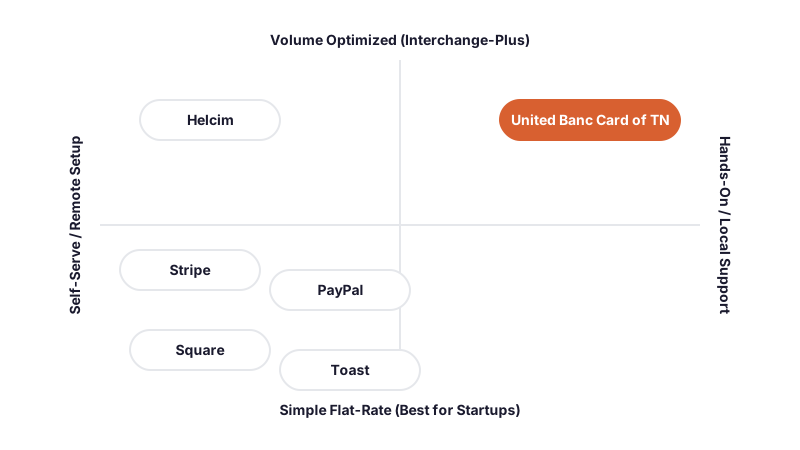
Processing rate structure. Flat-rate pricing (Square, PayPal, Stripe) is predictable but expensive at volume – 2.4–2.9% + $0.15–$0.30 per transaction adds up fast. Interchange-plus pricing (Helcim, United Banc Card of TN) passes actual card network costs through with a small markup, often saving $500–$1,000+/year for businesses processing $50K+/month. Know your monthly volume before comparing rates.
POS hardware and software compatibility. Some processors lock you into proprietary hardware (Toast requires Toast hardware; Square's full POS features require Square terminals). Others let you choose the software that fits your workflow – a convenience store has different needs than a full-service restaurant. Ask whether you can match the POS platform to your business type, or whether you're buying into one system regardless of fit.
Onsite vs. remote setup. Self-serve platforms (Square, Stripe, Helcim) can have you accepting payments in hours – genuinely useful for new businesses or simple setups. But for full POS deployments with kitchen display integration, employee management, and inventory configuration, remote onboarding often means the system sits partially configured for weeks. Onsite installation and training closes that gap.
Support model. Who do you call at 9 PM on a Friday? Some processors offer 24/7 chat; some offer phone support only during business hours (Elavon's sales team is available Mon–Fri 9AM–7PM EST). Local merchant services providers can often dispatch someone physically. Match the support model to your business's actual tolerance for downtime.
Contract terms and exit costs. Month-to-month contracts (Square, Helcim, Stripe) let you leave without penalty. Some processors include early termination fees or equipment buyout clauses – ask before signing. If you're switching from an existing processor, find out whether your new provider will help negotiate or absorb those costs.
Bundled services vs. best-of-breed. A single vendor handling POS, processing, ATM, and business lending means one accountable contact when something breaks. Best-of-breed (separate POS, separate processor, separate lending) sometimes wins on individual pricing but costs more in integration time and finger-pointing when things go wrong.
The Best Payment Processing Companies for Small Businesses
1. United Banc Card of TN
A Tennessee-based merchant services and POS solutions provider that bundles hardware, software, processing, installation, and 24/7 support from a single local point of contact – owner Karl.
Best for: Independent restaurants, bars, retail stores, food trucks, and service businesses in Tennessee that need onsite setup, personal accountability, and a POS matched to their specific business type.
Strengths
Every customer goes through Karl directly. Clients since 2009 describe calling him personally during operational issues and getting an immediate response – no national processor works that way at this tier.
POS options include Lavu (iPad restaurant POS), Clover (restaurant/retail), Korona (convenience/liquor store), and Retailcloud (combined in-store/online retail). The right system gets matched to the business instead of pushing one platform on everyone.
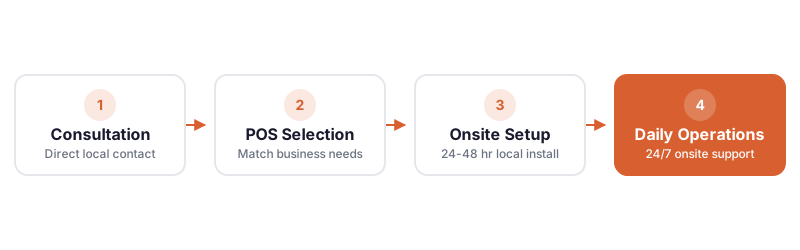
Staff arrive onsite, handle software programming, train employees, and get you live – usually within 24–48 hours. No partially configured system sitting idle for two weeks while you wait on a remote support ticket.
The full package: POS hardware free with a processing agreement, ATM placement, business funding through GoKapital (merchant cash advances, SBA loans, equipment leasing), pay-at-the-table tablets and QR codes, and a lifetime POS warranty.
On rate savings, Wacko Taco said it plainly: "The savings he said would be there was there, and then some. This was almost a shock by itself because every time we've been told this it was never true." That kind of skepticism is exactly what Karl is used to hearing – and has to earn.
Where it's not the right fit
- Processing rates are custom quotes, not published – merchants who need to compare rates on a spreadsheet before engaging will need to request a consultation first
- Primary strength is Tennessee and surrounding region; if local onsite service isn't a factor in your location, the core differentiator disappears
Pricing: POS hardware and software free with merchant processing agreement; terminal rentals from $8/month; processing rates by custom quote. Call (615) 476-0255 or visit unitedbanccardoftn.com.
When to choose it: You're a Tennessee-area independent restaurant, bar, or retail store that needs a complete setup handled by one person, wants the POS matched to your specific operation, and values having a local expert you can call directly when something breaks.
2. Helcim
A Canadian-based payment processor built around transparent interchange-plus pricing with automatic volume discounts, no monthly fees, and a bring-your-own-software integration model.
Best for: Tech-comfortable small and mid-size businesses processing $10K+/month online or $50K+/month in-person who want to minimize processing costs without switching their existing software.
Strengths
- In-person rate: interchange + 0.40% + $0.08 (average effective rate ~1.93% + $0.08) – lower than Square (2.4% + $0.15), PayPal (2.29% + $0.09), and Stripe (2.9% + $0.30 online)
- Automatic volume discounts kick in at $50K+/month with no negotiation – the rate just drops
- Payment Extension integration (launched January 2026) lets merchants keep their existing business software (Jobber, Workiz, GoHighLevel, 100+ platforms by end of 2026) while adding Helcim processing – solving the historic problem of forced software migration
- No monthly fees, no contracts, no cancellation fees
Where it's not the right fit
- Self-serve model with remote support; no onsite installation or local service team
- Less vertical expertise for restaurants or specialty retail – no bundled KDS, inventory, or employee management out of the box
Pricing: $0/month; in-person interchange + 0.40% + $0.08; online interchange + 0.50% + $0.25; $99 card reader (as of 2025).
When to choose it: You're processing $50K+/month, comfortable with self-serve software setup, and want to stop overpaying on flat-rate processing – especially if you already use business software and don't want to replace it.
3. Square
A flat-rate payment processor and POS platform designed for quick setup with no long-term contracts, widely used by new and small businesses across retail and food service.
Best for: New businesses and quick-service restaurants that want to accept payments within hours using a simple, predictable pricing model.
Strengths
- Sign up online and accept payments the same day – no onboarding process required
- 200+ app integrations across loyalty, scheduling, payroll, and e-commerce
- No monthly fee on the free tier; no contracts or cancellation fees
Where it's not the right fit
- Rates are higher at volume: 2.4–2.6% + $0.15 in-person; online rates jumped to 3.3% + $0.30 in January 2026 for free-tier users
- Full POS functionality requires paid plans ($49–$149/month) – the "free" entry point scales in cost as your operation grows
Pricing: $0–$149/month software; in-person 2.6% + $0.15 (free tier) to 2.4% + $0.15 (Premium); online 3.3% + $0.30 (free tier) as of 2025.
When to choose it: You're launching a new business or pop-up operation, need to accept payments today without a sales conversation, and your monthly volume is under $10K where flat-rate simplicity outweighs cost optimization.
4. Toast
A restaurant-specific POS platform combining hardware, software, kitchen display integration, and proprietary payment processing – the fastest-growing restaurant POS in the U.S.
Best for: Full-service restaurants processing $250K+/year that want deep kitchen-to-table workflow integration and are comfortable with bundled proprietary processing.
Strengths
- Purpose-built for restaurants: kitchen display system, handheld table-side terminals, online ordering, loyalty, scheduling, and payroll in one ecosystem
- Starter Kit at $0/month lowers the entry barrier – though processing rates of 3.09–3.69% + $0.15 reflect the cost
- Real-time fraud monitoring and restaurant-specific inventory management
Where it's not the right fit
- Locked into Toast Payments – cannot shop processing rates or use a third-party processor
- Realistic all-in cost runs $150–$400/month for a typical independent using online ordering, loyalty, and KDS – "nothing at Toast is free"
Pricing: $0–$578/month software; processing 2.49–3.69% + $0.15 depending on plan; hardware bundles from $0 (Starter Kit) as of 2025.
When to choose it: You run a full-service restaurant doing significant volume and want one deeply integrated system – and you've done the math on Toast's all-in monthly cost versus unbundled alternatives.
5. Stripe
A developer-first payment infrastructure platform built for online transactions, subscription billing, and custom-built checkout experiences.
Best for: E-commerce businesses, SaaS companies, and developer-built applications that need API-first payment infrastructure with global reach.
Strengths
- Industry-standard API with 1,000+ integrations; the documentation and developer tooling are genuinely best-in-class
- Supports subscriptions, payment links, invoicing, and global transactions in 135+ currencies
- Transparent flat-rate pricing with no monthly fees on standard plan
Where it's not the right fit
- Not designed for in-person retail or restaurant POS; Stripe Terminal is a premium add-on, not a core product
- At 2.9% + $0.30 per online transaction, costs accelerate quickly for high-volume businesses compared to interchange-plus alternatives
Pricing: $0/month; online 2.9% + $0.30 domestic; in-person via Stripe Terminal; hardware $59–$299 as of 2025.
When to choose it: You're building a software product, running an online store, or need payment infrastructure that developers can extend – and in-person POS is not a core requirement.
6. PayPal
A legacy digital wallet and payment processor with strong brand recognition, Zettle in-person reader support, and Venmo integration for peer-to-peer payment acceptance.
Best for: New sellers wanting a familiar checkout experience for their existing PayPal-heavy customer base, or businesses needing a secondary processor for digital wallet transactions.
Strengths
- Consumer brand recognition drives checkout conversion for PayPal-familiar shoppers
- Zettle in-person rate of 2.29% + $0.09 is competitive among flat-rate options
- Venmo acceptance at 1.9% + $0.10 is the lowest PayPal product rate available
Where it's not the right fit
- Online checkout rates of 2.99–3.49% + $0.49 are among the highest available from major processors
- Documented 180-day fund hold policy on account closure creates cash flow risk
- No native dual pricing/surcharging support; no POS ecosystem for restaurant or retail operations
Pricing: $0/month; in-person 2.29% + $0.09; online 2.99–3.49% + $0.49; Venmo 1.9% + $0.10 as of 2025.
When to choose it: You're a new seller or solo operator whose customers actively request PayPal checkout, and you're using it as a supplemental payment option rather than a primary processing platform.
Quick Comparison
| Tool | Best For | Starting Price | Free Tier | Standout Feature |
|---|---|---|---|---|
| United Banc Card of TN | Local TN restaurants & retail needing full-stack setup | Custom quote; terminals from $8/mo | POS hardware free with processing | Onsite installation + named-owner 24/7 support |
| Helcim | $50K+/month merchants optimizing rates | $0/month + interchange-plus | Yes | Automatic volume discounts, no negotiation |
| Square | New businesses needing same-day setup | $0/month software | Yes | Accept payments online within hours |
| Toast | Full-service restaurants with $250K+/year volume | $0–$578/month | Starter Kit at $0 | Purpose-built restaurant KDS + table management |
| Stripe | E-commerce and developer-built applications | $0/month | Yes | API-first infrastructure with 1,000+ integrations |
| PayPal | Secondary checkout for PayPal-loyal customers | $0/month | Yes | Venmo acceptance at 1.9% + $0.10 |
Pricing as of early 2025. Check each tool's pricing page for current rates.
Which Payment Processing Company Should You Choose?
If you're an independent restaurant, bar, or retailer in Tennessee…
United Banc Card of TN is the right call. The combination of onsite installation, POS matched to your specific operation (Lavu for restaurants, Korona for liquor stores, Retailcloud for retail), and direct access to Karl means you're not navigating a support queue when something breaks at 7 PM on a Friday.
If you're processing $50K+/month and want to cut fees…
Helcim wins on pure cost. Their interchange-plus model at ~1.93% + $0.08 in-person beats every flat-rate alternative in the market at that volume, and the automatic volume discounts require zero negotiation. If you're tech-comfortable and don't need onsite support, the annual savings are real.
If you're launching a new business and need to accept payments today…
Square is the fastest path from zero to processing. No contracts, no onboarding, sign up online and use the free card reader. The flat-rate pricing is higher at volume, but for a business just starting out, the simplicity is worth it.
If you run a high-volume full-service restaurant…
Toast offers the deepest restaurant-specific feature set – kitchen display systems, handheld table-side terminals, and integrated scheduling. Run the all-in math (software + processing + add-ons) before committing, but for $250K+/year operators who want one tightly integrated platform, Toast's vertical depth is hard to match.
If your business is primarily online or developer-built…
Stripe is the default choice for e-commerce, SaaS, and subscription businesses. The API quality is genuinely hard to beat, and the integration ecosystem covers almost every use case; if you're building a product rather than running a counter, Stripe is the right foundation.
If your customers specifically request PayPal checkout…
PayPal works best as a supplemental option, not a primary processor. The Zettle in-person rate (2.29% + $0.09) is competitive, but the high online rates and fund-hold risk make it a poor choice as your only processor.
Ready to Try United Banc Card of TN?
If you're a Tennessee-area restaurant, bar, retailer, or service business that needs a complete setup – POS matched to your operation, onsite installation, processing rates that actually materialize, and a local expert you can call directly – United Banc Card of TN is the right fit. Call Karl at (615) 476-0255 or request a free quote online. Most setups are complete within 24–48 hours, and POS hardware is free with your merchant processing agreement.
Frequently Asked Questions
What should I look for in a payment processing company for my small business?
Processing rate structure, POS hardware compatibility, onsite versus remote setup, support availability, and contract terms are the five core factors that separate processors at small business scale. Flat-rate pricing (Square, PayPal) is predictable but expensive at volume; interchange-plus (Helcim, United Banc Card of TN) saves hundreds annually for businesses processing $50K+/month. Match the processor's support model to your downtime tolerance – national chat-based support differs fundamentally from local dispatch or phone-based accountability.
Why do small businesses switch payment processors?
Fee increases are the primary trigger; Square raised online rates 14% in January 2026, costing a $20K/month business roughly $800/year in new charges. Support quality is the second driver-national processors offer chat queues, not phone calls to humans who arrive onsite during Saturday dinner rushes. A third pattern is outgrowing the original platform; food trucks that started with Square readers eventually need inventory management and employee scheduling that flat-rate POS ecosystems either don't offer or deliver at premium cost.
What's the difference between flat-rate and interchange-plus payment processing?
Flat-rate processors (Square at 2.4% + $0.15, PayPal at 2.29% + $0.09) charge the same percentage and per-transaction fee regardless of card type, volume, or risk-predictable but expensive at scale. Interchange-plus processors (Helcim at interchange + 0.40% + $0.08) pass the actual credit card network cost through with a small markup, typically resulting in 1.93% effective rates at volume and automatic discounts as monthly processing climbs. For businesses under $10K/month, flat-rate simplicity wins; above $50K/month, interchange-plus almost always saves $500–$1,000 annually.
Is United Banc Card of TN only available in Tennessee?
United Banc Card of TN's core strength is local onsite service, installation, and personal accountability from owner Karl in the Tennessee market-that's where the differentiation is most valuable. The site references nationwide merchant services on some pages, but the proof points (named customer testimonials, physical installation within 24–48 hours, direct phone access) are concentrated in Tennessee cities like Nashville, Murfreesboro, and Franklin. For merchants outside Tennessee seeking similar full-stack local service, the regional model is the actual product; geographic scope beyond Tennessee should be confirmed directly at (615) 476-0255.
Can I keep my existing POS software if I switch to a new payment processor?
Most flat-rate processors (Square, Toast, PayPal) lock you into their proprietary POS ecosystems-you buy the system, not just the processing. United Banc Card of TN and Helcim offer flexibility: United Banc Card bundles compatible platforms (Lavu, Clover, Korona, Retailcloud) matched to your business type, while Helcim's new Payment Extension integration (launched January 2026) lets you keep existing business software (Jobber, Workiz, GoHighLevel, 100+ platforms by end of 2026) and add processing on top. If your workflow is built into your current system, interchange-plus or flexible bundlers prevent forced migration.
What is the advantage of onsite POS installation versus remote setup?
Onsite installation (United Banc Card of TN's model) means staff physically arrive, configure hardware, program software, train employees, and validate go-live within 24–48 hours-you're live and confident immediately. Remote setup (Square, Helcim, Stripe) can have you accepting payments within hours, but full POS deployments with kitchen display systems, employee management, and inventory often sit partially configured for weeks while merchants work through documentation. For simple operations or new businesses, remote speed wins; for restaurants or retail with complex workflows, onsite eliminates the