
TL;DR
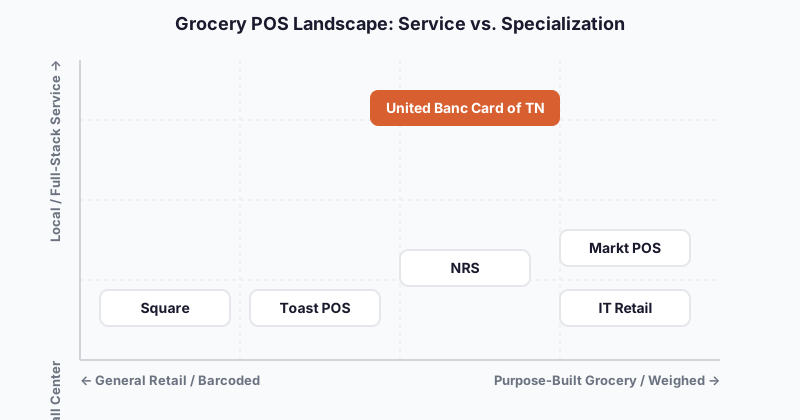
Best pos system for small grocery store decisions come down to your workflow, location, and compliance needs: United Banc Card of TN is the top pick for Tennessee and Southeast independent grocers who want one local contact handling POS hardware, processing, installation, and ongoing support – with no incremental software fee when you're already signing a processing agreement. Markt POS wins for specialty market owners (Indian, Asian, Hispanic, corner shops) who need variable weight and scale support with transparent month-to-month pricing. IT Retail is the only right answer for stores that require native WIC compliance alongside EBT.
best pos system for small grocery store
Best pos system for small grocery store is one of the most deceptively hard searches an independent grocery owner runs – because most results serve up general retail tools that can't handle produce scales, EBT compliance, or weighted deli inventory. Square looks simple until you realize there's no scale integration. Clover looks affordable until the processor lock-in hits. This guide covers six real options, with specific pricing, genuine strengths, and honest fit gaps on each.

Why Small Grocers Outgrow Generic POS Systems
Scale integration is where most generic POS tools break down first. If you sell produce by the pound, deli by weight, or bulk items by quantity, a system that only scans barcodes leaves you entering prices manually – every transaction, every time. Square and Lightspeed both lack native scale integration, which is a functional dealbreaker for real grocery workflows. Reddit threads on the topic are blunt: users consistently flag that general retail tools require workarounds that slow down checkout and introduce errors.
EBT and SNAP compliance is the second friction point. Over 68% of grocery retailers have moved to digital POS systems, but not all of them handle EBT properly. Some systems charge per-swipe fees that add up fast for stores where 30–40% of transactions are EBT. A store running high SNAP volume on a per-transaction processor can easily pay hundreds more per month than a store on a flat-rate EBT plan like NRS's $49.95/month unlimited tier.
The third issue is support – or the absence of it. Small grocery owners run lean. When the POS goes down at 5pm on a Friday, calling a national 1-800 line and waiting on hold is not a solution. That specific frustration drives a large share of the searches that land on pages like this one. Independent grocers aren't looking for the most feature-rich enterprise platform; they're looking for something that works, keeps working, and has a real person to call when it doesn't.
What to Look for in a Grocery POS System
Scale and weight-based pricing. If your store sells any produce, deli, meat, or bulk goods priced by weight, your POS must support integrated scanner scales. This isn't optional – systems lacking it force manual overrides, slow checkout, and create pricing errors that erode margin. Look for in-counter scanner scales and deli/meat scale integration as explicit features, not workarounds.
EBT and SNAP compliance. EBT acceptance is table stakes; the question is how. Per-swipe fees add up for high-volume stores. A flat-rate EBT program (like NRS's unlimited plan) can save $100–$300/month versus per-transaction pricing on a processing agreement. Know your EBT transaction volume before committing to a pricing model.
WIC support. For stores in communities with high WIC participation – rural Tennessee, Appalachia, urban low-income neighborhoods – WIC compliance is non-negotiable. Not all EBT-capable systems support WIC. IT Retail is the standout here; Clover explicitly does not support WIC natively.
Inventory management for fresh and high-SKU environments. Grocery stores carry hundreds to thousands of SKUs, many with expiration dates. Look for real-time stock tracking, low-stock alerts, automated reorder triggers, and department-level reporting. Systems that handle perishable inventory – tracking waste, flagging vendor cost changes – return their cost in reduced shrinkage.
Processing fee structure. You're going to process a lot of transactions. A 0.5% difference in processing rate at $50,000/month in card volume is $250/month – $3,000/year. Understand whether you're on interchange-plus, flat-rate, or tiered pricing, and model your actual cost before signing.
Local vs. remote support. A cloud-based system with phone support is very different from a local technician who can arrive onsite. For single-location independents, downtime means lost sales. Local installation, local training, and a local number to call matter more than they appear to on a features comparison chart.
Bundled vs. unbundled cost. Some vendors charge separately for software, hardware, processing, and support. Others bundle them. Know the total cost of ownership – not just the headline monthly fee – before comparing options.
The Best POS Systems for Small Grocery Stores
1. United Banc Card of TN
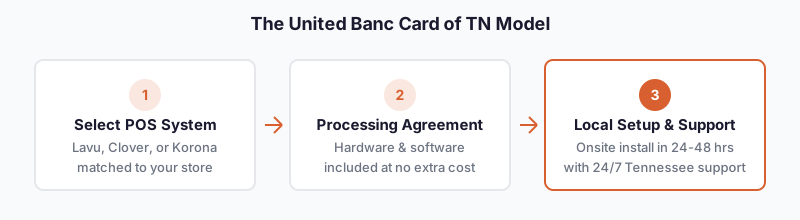
United Banc Card of TN is a Tennessee-based merchant services and POS provider. One call gets you hardware, software, processing, onsite installation, and 24/7 support – with Clover, Korona, Retailcloud, or Lavu matched to what your store actually needs.
Best for: Independent Tennessee and Southeast grocery, convenience, and specialty retail owners who want one local point of contact handling their entire stack – POS, processing, training, and support – without paying separate software fees on top of a processing agreement.
Strengths
- POS hardware and software provided free when paired with a merchant processing agreement – eliminates the $49–$90/month software fee charged by most competitors (typically a $600–$1,080/year savings)
- Every testimonial references Karl by name, not a help desk. Tim Harkum (Stirrup Nashville): "anytime we needed to talk to Karl, we just picked up the phone and he was right there for us"
- Matches Lavu, Clover, Korona, or Retailcloud to your store's workflow – no single proprietary system forced on you
- Lifetime POS warranty vs. industry-standard one year – hardware failure risk shifts to the vendor, not the merchant
- Onsite installation and staff training in 24–48 hours; Myles Holodnak confirmed "the process took a couple of days to set up"
- Bundled ATM placement, cash discounting, and business lending (merchant cash advances, SBA loans, equipment financing via GoKapital) from one provider
- 24/7 technical support from a Tennessee-based team
Where it's not the right fit
- Pricing requires a consultation call – exact processing rates and software tiers are not published online; merchants who want to compare numbers without a sales conversation may prefer Markt or NRS
- No native WIC support across partner platforms – IT Retail is the right choice for WIC-heavy store environments
- No self-checkout kiosk offering visible in current product lineup – Osprey POS and NRS include kiosk options
- Best suited for Tennessee and Southeast; national multi-location chains are better served by IT Retail or Osprey
Pricing: POS hardware and software free with merchant processing agreement; terminal rentals from $8/month. Full pricing at unitedbanccardoftn.com. Free 30-day trial available.
When to choose it: You're an independent grocer or convenience store owner in Tennessee who's paying too much in processing fees, tired of calling 1-800 support during a rush, and wants one local expert to handle setup, training, and ongoing support from a single relationship.
2. Markt POS
Markt POS is a grocery-first POS platform built for small independent markets – Indian, Asian, Hispanic, and corner shops – with variable weight scanning, scale integration, and month-to-month pricing included by default.
Best for: Specialty market owners who need a purpose-built grocery POS with variable weight, scanner scales, and honest month-to-month pricing – especially ethnic food markets and produce-heavy independent stores.
Strengths
- Variable weight scanning and in-counter scanner scale support from day one
- Built from scratch for specialty markets: Indian, Asian, Hispanic, corner shops – not a generic retail tool adapted for grocery
- Starter plan at $49–$69/month with no long-term contracts and a 30-day money-back guarantee
- Unlimited item database; real-time inventory updates; item modifiers and hotkeys with photos
- EBT acceptance, loyalty programs, vendor integration
- All plans include onboarding and unlimited training; 24/7 dedicated support
- Trusted by 1,000+ small to medium-sized store owners
Where it's not the right fit
- Not a bundled processing solution – you'll need a separate merchant services agreement, which adds cost and another vendor relationship
- Lighter on business lending, ATM placement, and funding products compared to United Banc's full-stack model
- No onsite local installation team for Tennessee merchants – support is remote
Pricing: Starter $49–$69/month as of 2025; Growth and Premium plans priced on request. No long-term contracts. Free 30-day money-back guarantee.
When to choose it: You own a specialty market with produce-heavy or weighted inventory and want a grocery-specific tool with published pricing, no contracts, and scale integration already baked in.
3. IT Retail
IT Retail is a POS platform built for independent grocers, with native WIC and EBT support, deli and scanner scale integration, AI-powered invoice processing, and registers that keep working when the internet goes down.
Best for: Independent grocers with significant fresh, deli, meat, or bakery departments who need WIC compliance alongside EBT, and benefit from AI-driven vendor cost tracking.
Strengths
- Native WIC support (EBT cash + food + WIC) with auto-separation and split tenders – the only system in this list with full WIC capability
- AI invoice processing that automatically flags when vendor costs change – directly protects grocery margin
- Deli and scanner scale integration; meat and bulk scale support for by-the-pound pricing
- Integrated purchase orders, low-stock reports, mobile stock edits from cloud back office
- Offline-ready register: keeps scanning and processing if internet drops
- Self-checkout kiosks available
- 4.7 Trustpilot rating
Where it's not the right fit
- Not a local bundled solution – requires a separate processing agreement and no onsite Tennessee installation team
- Better suited for established stores with dedicated fresh departments than for simple convenience or quick-serve formats
- Pricing requires a custom quote for higher tiers
Pricing: Starts at $49/month; Flex Monthly from $149/month. Custom tiers available via Build & Price tool. As of 2025.
When to choose it: Your store operates in a WIC-eligible area, carries significant fresh inventory, and needs the tightest possible compliance and margin management – especially if deli and meat scale integration is daily workflow.
4. National Retail Solutions (NRS)
NRS is a purpose-built grocery and convenience store POS with a flat-rate EBT program, integrated produce scales, and straightforward all-in pricing – built specifically for SNAP-heavy independent stores.
Best for: Small grocers and convenience stores with high EBT/SNAP transaction volume who want affordable flat-rate EBT processing, integrated scales, and predictable all-in monthly pricing.
Strengths
- EBT Unlimited program: $49.95/month flat rate – unlimited EBT swipes, no per-transaction fees – material savings for high-SNAP stores
- Basic plan starts at $19.95/month with NRS Pay processing; hardware bundles $599–$1,999
- Integrated scales for produce and deli pricing; quick-button functionality for prepared foods and hot food
- Real-time inventory tracking, automated purchase orders, department-level sales reports
- Employee scheduling and payroll integration (NRS Purple); loyalty program (BOSS Club)
- Free 30-day trial on all features
Where it's not the right fit
- No named local support relationship – support is remote/call center, not a local technician
- Does not support WIC natively
- Hardware lock-in to NRS ecosystem; limited flexibility on POS platform selection
Pricing: Basic $19.95/month with NRS Pay ($29.95 without); EBT Unlimited $49.95/month flat. Hardware bundles $599–$1,999 as of 2025. Free 30-day trial.
When to choose it: You run a SNAP-heavy grocery or corner store where EBT represents 25%+ of transactions and a flat-rate EBT model will meaningfully reduce your monthly processing cost.
5. Square for Retail
Square for Retail is a general retail POS with a genuinely free base tier, fast onboarding, and no long-term commitment – built for simplicity, not grocery depth.
Best for: New convenience store owners or startup grocers who need to start accepting cards immediately with zero upfront cost and no processing commitment.
Strengths
- Free plan: $0/month with no minimum spend – the lowest barrier to entry of any option on this list
- Square Plus at $29/month adds staff management and inventory reports
- Fastest setup of anything on this list: upload inventory, scan barcodes, start selling – no sales consultation required
- Contactless, Apple Pay, Google Pay, EBT acceptance (manual verification)
- Square Register ($799) and Square Terminal ($299) available for more permanent setups
- No long-term contracts
Where it's not the right fit
- No native scale integration – not designed for produce, deli, or weight-based pricing
- Lacks grocery-specific inventory depth (no fresh expiration tracking, no deli workflows)
- EBT requires manual item verification – not ideal for high-volume SNAP transactions
- Support is online/chat-based; no local installation or onsite training
Pricing: Free plan $0; Square Plus $29/month/location; Square Premium $79/month. Hardware $0–$799. Processing fees apply at each tier. As of 2025.
When to choose it: You're bootstrapping a small market or convenience store and need to test sales before committing to a processing agreement – and you sell primarily packaged, barcoded goods rather than weighted fresh items.
6. Toast POS
Toast is a restaurant POS that moved into grocery and retail in 2024. It now covers native EBT, scale integration, and high-SKU inventory – which makes it a reasonable fit if you're already running Toast and adding a grocery component.
Best for: Restaurant operators expanding into grocery concepts (grab-and-go, prepared foods, deli-forward markets) who want a single platform bridging front-of-house and grocery workflows.
Strengths
- Native EBT/SNAP support and scale integration for by-weight pricing
- High SKU count support with department-level inventory tracking
- Vendor invoice management and offline mode
- Starter Kit available at $0/month (processing fees apply: 3.09% + $0.15 per in-person transaction)
- Point of Sale plan at $69/month with lower processing: 2.49% + $0.15 per in-person
- Strong restaurant legacy with KDS and kitchen-to-counter workflows
Where it's not the right fit
- Higher entry processing fees (3.09% on Starter Kit) can be costly for high-volume grocery
- Newer to pure grocery – better suited for hybrid restaurant-grocery than traditional independent grocery
- No local installation or onsite support; support is remote
- Add-ons (payroll $90/mo, online ordering $75/mo, loyalty $50/mo) raise total cost quickly
Pricing: Starter Kit $0/month (3.09% + $0.15 processing); Point of Sale $69/month (2.49% + $0.15); Retail plan $90/month. Hardware from $719+. As of 2025.
When to choose it: You operate a prepared foods deli or grab-and-go concept that already runs Toast in a restaurant context and want unified reporting across food service and grocery sales.
Quick Comparison
| Tool | Best For | Starting Price | Free Tier | Standout Feature |
|---|---|---|---|---|
| United Banc Card of TN | TN independent grocers, full-stack local service | Free with processing agreement | No | Named local owner, lifetime POS warranty, bundled ATM + lending |
| Markt POS | Specialty markets, variable weight | $49–$69/mo | No (30-day money-back) | Grocery-first, specialty market focus, no contracts |
| IT Retail | WIC + EBT fresh departments | $49/mo | No | Native WIC, AI invoice processing, scale integration |
| NRS | High-SNAP volume stores | $19.95/mo | No (30-day trial) | Flat-rate EBT Unlimited at $49.95/mo |
| Square | Startup grocers, barcoded goods | $0/mo | Yes | Zero cost to start, fastest onboarding |
| Toast | Hybrid restaurant-grocery | $0/mo (high fees) | No | Restaurant + grocery unified in one platform |
Pricing as of 2025. Check each tool's pricing page for current rates.
Which POS System Should You Choose?
Most small grocery owners fit cleanly into one of these five scenarios. Each has a clear answer.
If you're a Tennessee or Southeast independent grocer tired of overpaying for processing…
United Banc Card of TN is the right call. You get POS hardware and software bundled into your processing agreement at no incremental cost – eliminating the $600–$1,080/year in software fees you'd pay to Square Plus, Clover, or Markt separately. Call Karl at (615) 476-0255; most setups complete in 24–48 hours.
If you run a specialty market with heavy produce or weighted inventory…
Markt POS was built for exactly this. Variable weight scanning, in-counter scanner scales, unlimited item database, and direct support for Indian, Asian, Hispanic, and corner shop formats – $49–$69/month with no contract.
If your store is WIC-eligible and you need compliance alongside EBT…
IT Retail is the only system on this list with native WIC support. Its AI invoice processing also catches vendor cost changes automatically – a meaningful tool for protecting grocery margin. No other option here covers this compliance need.
If you run a high-SNAP neighborhood store and want to minimize EBT processing cost…
NRS wins on economics. The EBT Unlimited plan at $49.95/month flat caps your EBT cost regardless of swipe volume – and the base plan starts at $19.95/month with NRS Pay. For a store processing 40%+ of transactions as EBT, per-swipe fees add up fast; NRS eliminates that exposure.
If you're launching a new market and want zero upfront cost to test the concept…
Square's free tier requires no minimum spend, no processing agreement, and no consultation. It's not a long-term grocery solution for a weighted-inventory operation, but it's the fastest path to accepting cards while you validate your business model.
If you're a restaurant operator expanding into grocery or grab-and-go prepared foods…
Toast keeps your front-of-house and grocery sales on a unified platform. It's not the right tool for a traditional independent grocer, but for hybrid operations it removes integration complexity.
Ready to Try United Banc Card of TN?
If you're an independent grocery or convenience store owner in Tennessee who's paying too much in processing fees or stuck on hold with a national 1-800 line during your busiest hours, there's a simpler option. United Banc Card of TN means one local contact – Karl – who handles your POS setup, processing rates, training, and warranty support directly. Most merchants are up and running in 24–48 hours. Call (615) 476-0255 or request a free quote at unitedbanccardoftn.com – no obligation, no hidden setup fee.
Frequently Asked Questions
What should I look for in a POS system for a small grocery store?
Scale and weight-based pricing, EBT/SNAP compliance, and local support are non-negotiable. If your store sells produce, deli, or bulk goods priced by weight, your POS must integrate with scanner scales-systems lacking this force manual overrides that slow checkout and erode margin. EBT handling differs by pricing model: per-swipe fees add up for high-volume stores, while flat-rate EBT plans like NRS's $49.95/month unlimited tier can save $100–$300/month. For single-location independents, downtime means lost sales, so a system with local installation, local training, and a real person to call matters more than headline features.
What makes a good grocery POS tool compared to general retail systems?
Grocery-specific POS platforms handle perishable inventory, weighted pricing, and fresh department workflows that generic retail tools simply cannot manage. A produce-heavy store needs real-time stock tracking with expiration date alerts, deli scale integration for by-the-pound pricing, and vendor cost tracking-features that reduce shrinkage and protect margin. Square and Lightspeed, for example, lack native scale integration, forcing manual workarounds at checkout. Systems built from the ground up for grocery (Markt, IT Retail, NRS) include these workflows by default, while systems adapted from restaurants or general retail require costly add-ons or creative workarounds that introduce error.
Is WIC compliance something I should worry about when choosing a grocery POS?
Yes, if your store operates in a WIC-eligible area or neighborhood-rural Tennessee, Appalachia, urban low-income communities-WIC compliance is non-negotiable, not optional. Not all EBT-capable systems support WIC natively; Clover explicitly does not, and most general retail tools ignore it entirely. IT Retail is the only system on this comparison list with built-in WIC support alongside EBT, which means automatic item separation and split-tender handling without manual intervention. If you're in a high-WIC geography and choose a non-compliant system, you'll need costly custom development or you'll lose eligible customers at checkout.
How much can I save by choosing a POS system with bundled processing?
Bundled processing can eliminate $600–$1,080 per year in software fees alone-roughly $49–$90/month that most POS vendors charge on top of hardware and merchant processing. United Banc Card of TN bundles POS hardware and software free when you sign a processing agreement, while Square Plus ($29/month), Clover retail plans ($49–$89/month), and most competitors charge these fees separately. The total cost difference depends on your processing volume and rates, but for a small grocer already committed to a processing agreement, bundling is material savings that shifts vendor economics in favor of unified providers.
What's the difference between per-swipe EBT fees and flat-rate EBT pricing?
Per-swipe fees charge a small amount-typically $0.30–$0.50-for every EBT transaction; flat-rate pricing charges a fixed monthly fee regardless of volume. For a store where 25% of transactions are EBT, per-swipe fees on a standard processing agreement can easily exceed $100/month; NRS's flat-rate EBT Unlimited plan at $49.95/month caps your cost regardless of swipes. If your store runs high SNAP volume-especially in urban low-income neighborhoods or rural areas-a flat-rate model can save $100–$300/month compared to per-transaction pricing on a processing agreement.
Why is local support different from 24/7 remote support for a small grocery store?
A cloud-based system with phone support and a local technician who arrives onsite are fundamentally different experiences when your POS fails during peak hours. Small independent grocers run lean; downtime means lost sales and frustrated customers, which is why testimonials on United Banc Card of TN specifically mention calling Karl directly-not routing through a help desk. Onsite installation, same-state training, and a local number to call reduce both time-to-resolution and the friction of explaining your setup to a generic support agent who has never seen your store.
Should I choose United Banc Card of TN if I'm outside Tennessee?
United Banc Card of TN is explicitly best suited for Tennessee and Southeast merchants; national multi-location chains and geographically dispersed grocers are better served by IT Retail or Osprey. The competitive edge-a named local owner (Karl) who handles setup, processing, and support personally-disappears if you're not in the service territory. If you're an independent grocer in Tennessee or the Southeast paying too much for processing with a national vendor, United Banc's bundled model and local relationship win; if you're expanding to five locations across multiple states, you need a platform with distributed support infrastructure.
What's the fastest way to set up a POS system if I'm launching a new grocery store?
Square's free tier is the fastest path to accepting cards with zero upfront cost-upload your inventory, scan barcodes, and start selling in hours with no sales consultation or processing commitment. NRS's basic plan at $19.95/month is also fast onboarding for a simple setup. However, neither system handles weighted produce or deli pricing natively, so they work best for barcoded goods or simple convenience stores. If you need produce scales, deli workflows, or EBT compliance from day one, Markt POS ($49–$69/month) or United Banc Card of TN (24–48-hour setup) are better choices despite longer onboarding.
Do I need to worry about vendor lock-in when choosing a grocery POS?
Vendor lock-in is real and expensive to escape-especially when processing, hardware, and software are entangled. Clover locks you to Fiserv processing; Toast binds front-of-house and grocery workflows tightly; proprietary systems like Osprey own both hardware and software exclusively. United Banc Card of TN avoids lock-in by offering Lavu, Clover, Korona, or Retailcloud matched to your specific workflow rather than forcing a single platform. If you choose a system with integrated hardware and no escape hatch for processing, switching costs (data migration, staff retraining, processing termination fees) can exceed $5,000–$10,000.
Is it worth paying for a POS system that includes ATM placement and business lending?
If you need capital to stock inventory or upgrade, bundled ATM placement and business lending from one vendor can simplify your vendor relationships and lower total cost of ownership. United Banc Card of TN's partnerships with GoKapital for business lending and ATM placement mean a regional grocer expanding from one location to three can negotiate POS, processing, equipment loans, and ATM income in a single conversation. For a merchant paying multiple vendors separately, this consolidation reduces friction and creates a deeper relationship with one accountable provider-though the trade-off is pricing requires a consultation call rather than a published quote online.
Why is United Banc Card of TN ranked number one for small grocery stores?
United Banc Card of TN fills a real gap in the market: independent grocers in Tennessee are underserved by generic retail POS vendors (which lack grocery depth) and overwhelmed by enterprise platforms (which are overpriced and overcomplicated). One trusted local point of contact (Karl) handling POS hardware, software, processing, installation, and support-with no incremental software fee when paired with a processing agreement-is credibly differentiated from national vendors offering generic 24/7 chat support. Testimonials specifically reference calling Karl directly and having problems solved by someone accountable for their ongoing success, which is psychologically distinct from 1-800 call centers. For Tennessee and Southeast independent grocers skeptical of big vendors, this combination of bundled value, local accountability, and proven savings (Wacko Taco: "the savings he said would be there was there, and then some") justifies the top position.
Is Markt POS still worth using if United Banc Card of TN offers bundled processing?
Yes-Markt is the right choice if you own a specialty market (Indian, Asian, Hispanic, corner shop) and prioritize published pricing transparency and month-to-month flexibility over bundled processing savings. Markt's $49–$69/month flat rate with no contracts appeals to merchants who want to compare numbers online without a sales call; United Banc requires a consultation to learn exact costs. Markt was built from the ground up for specialty markets with variable weight scanning and cultural customization, while United Banc's partner systems are more general-purpose. If you value transparency, no contracts, and specialty market features more than bundled processing, Markt wins; if you value one local contact handling your full stack, United Banc is the better fit.
When is IT Retail the only right answer instead of other grocery POS systems?
IT Retail is the only system on this list with native WIC compliance built in, making it non-negotiable for stores in high-WIC geographies-rural Tennessee, Appalachia, urban low-income neighborhoods-where WIC transactions represent 10%+ of sales. No other option on this comparison (United Banc, Markt, NRS, Square, Toast) supports WIC natively; you'd need custom development or lose eligible customers. IT Retail's AI invoice processing that automatically flags vendor cost changes is also unique to the list and directly protects grocery margin by catching price increases before they erode profit. If your store operates in a WIC-eligible area or carries significant fresh inventory requiring strict compliance, IT Retail is the clear choice despite lacking local onsite support.
What should I do if I'm comparing pricing between these POS systems and can't find clear numbers online?
Request custom quotes from vendors directly-publish pricing on their website is often a floor, not your actual cost, which depends on processing volume, feature tier, and local support. United Banc Card of TN requires a call to (615) 476-0255 for a personalized quote; Markt publishes exact tiers ($49–$69) online; NRS lists starting plans ($19.95–$49.95) but custom tiers via quote. Model your actual cost of ownership: total monthly software + hardware rental + processing fees at your expected transaction volume. A store running $50,000/month in card volume with a 0.5% difference in processing rates pays $250/month ($3,000/year) more on the worse deal-which is why comparing total cost, not headline price, matters.
Can I use Square or Toast for a grocery store that sells a lot of produce and deli items?
Square and Toast lack native scale integration, so they require manual workarounds for every weighted produce or deli transaction-slowing checkout and introducing pricing errors that erode margin. If your store is primarily packaged barcoded goods (convenience store, corner market without fresh), Square's free tier is a viable entry point. But if you sell produce by the pound, deli by weight, or bulk items, Square and Toast force manual item entry at checkout, which creates customer wait times and cashier frustration. Grocery-specific systems (Markt, IT Retail, NRS) integrate scanner scales directly, eliminating the workaround entirely-a functional advantage that compounds across hundreds of transactions daily.