
TL;DR
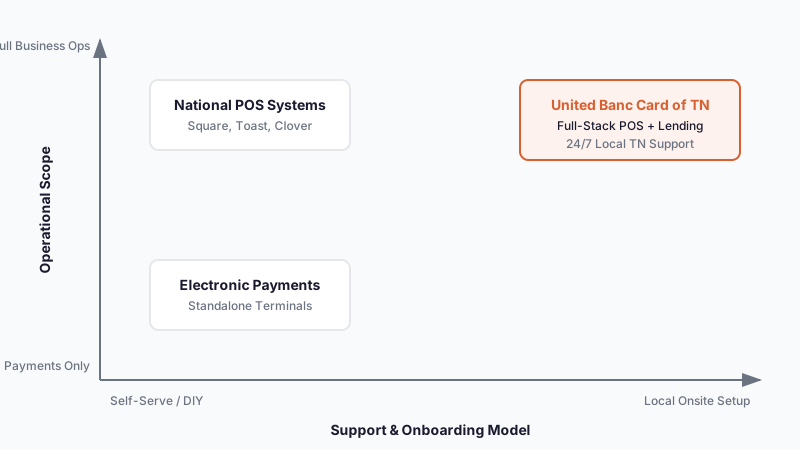
POS Systems for Restaurant and Retail vs Electronic Payments is a question of operational scope. Full POS systems handle complete business management: orders, inventory, staff scheduling, and payments in one platform. Electronic payment solutions handle card acceptance only, with no workflow or inventory layer. Choose a full POS if you need order routing, stock tracking, and reporting. Choose a standalone payment terminal if you only need to accept cards with minimal overhead.
POS Systems for Restaurant and Retail vs Electronic Payments
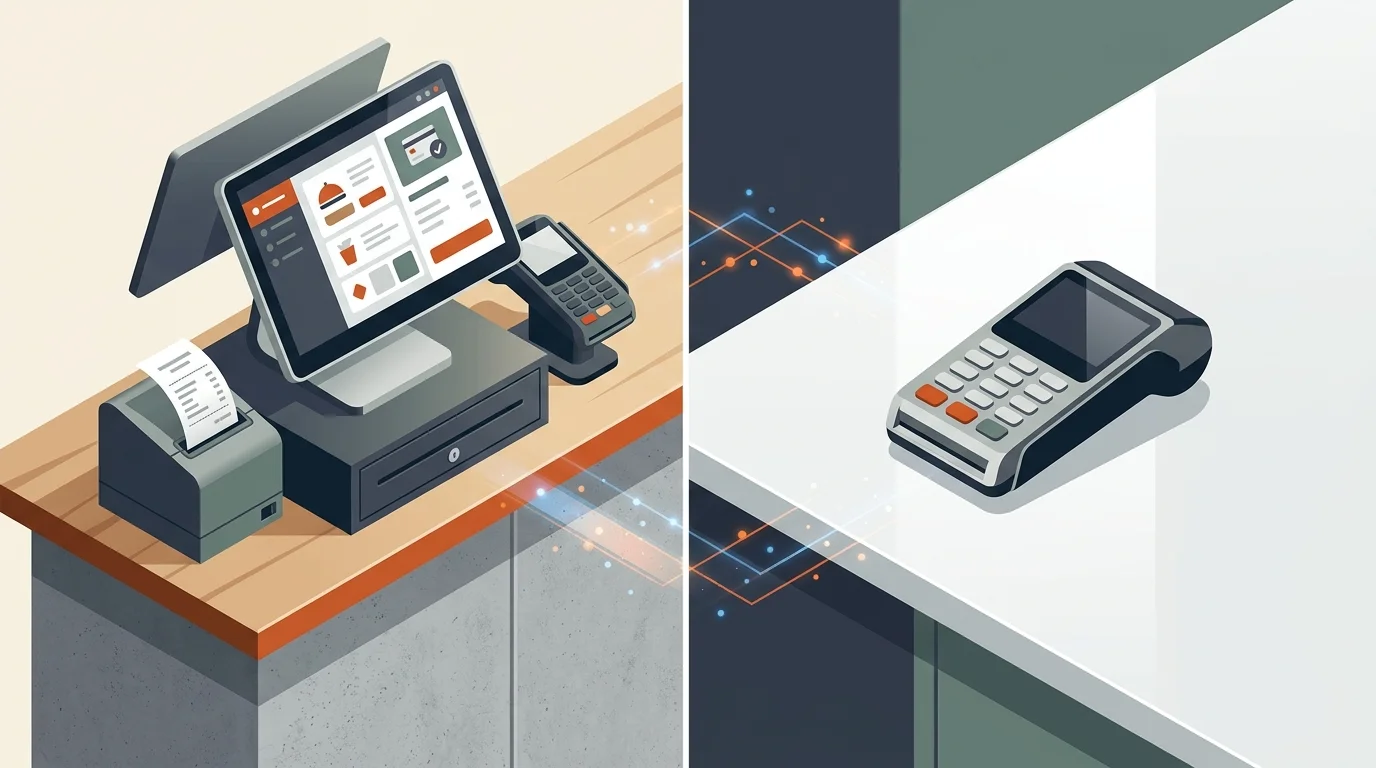
Full-featured POS platforms like Toast, Square POS, and Clover combine order management, inventory tracking, and payment processing into one system built for the daily realities of restaurants and retail stores. Electronic payment solutions, whether standalone card readers, payment terminals, or payment gateways, do one thing: accept cards. This page breaks down what each approach actually delivers, where each wins, and where a third option closes the gap neither covers well.
What Are POS Systems for Restaurant and Retail?
Dedicated restaurant and retail POS platforms are end-to-end business management tools that happen to process payments. The core of a restaurant POS is order flow: servers enter orders on a tablet, tickets route directly to a Kitchen Display System (KDS), the bar queue updates in real time, and the table closes with a split-bill payment and gratuity – all tracked in a single system. Retail POS platforms center on inventory: every sale updates SKU counts, reorder alerts fire automatically, and purchase history feeds into customer loyalty programs.
The leading names here – Toast, Square POS, and Clover – have built ecosystems around these workflows. Toast integrates with DoorDash and Uber Eats natively, offers SMS marketing campaigns, and provides labor cost reporting alongside food cost analytics. Square has layered in Square Invoices, Square Appointments, and a growing third-party app marketplace. Clover's flexible hardware lineup (Flex, Mini, Station Solo) serves both countertop and handheld use cases across industries.
Pricing for full POS platforms reflects their complexity. Toast's Starter Kit runs approximately $0–$69/month per terminal, with Essentials plans around $165/month; hardware alone runs $5,000–$15,000 for a full restaurant setup and contracts typically span 2–3 years with early termination fees. Square POS ranges from a free tier to $49/month per location (Plus) and $149/month (Premium). Clover's Restaurant Starter begins at $89.95/month plus an $849 upfront hardware fee, scaling to $129.85/month for full-service restaurant setups with $2,648–$4,447 in hardware.
The tradeoff is complexity. Staff training, system configuration, and ongoing software management all require real time and money. For a business that runs more than 50 transactions a day, manages rotating inventory, or coordinates front-of-house and back-of-house operations, that investment is worth it. For a mobile vendor or a service business that simply needs to accept a card, it usually isn't.
What Are Electronic Payments?
Electronic payment solutions are narrowly focused on card acceptance: hardware terminals, mobile card readers, payment gateways, and contactless payment infrastructure. They accept EMV chip cards, NFC contactless payments (Apple Pay, Google Pay), swipe transactions, and keyed entry, with minimal setup required.
This category spans a lot of ground: a $59 Square Reader for chip and contactless payments, a countertop terminal like the PAX A920 or Dejavoo, or a full payment gateway like PaymentsHUB or Stripe Terminal. They're all payment infrastructure, not business management tools. There is no order queue, no inventory layer, no table management, no KDS. You accept a payment, the transaction is approved, and the settlement hits your account.
The appeal is simplicity and cost. A food truck operator who takes ten orders an hour and manages inventory manually doesn't need a $150/month POS subscription. A professional services company that invoices clients doesn't need kitchen display integration. A pop-up retail vendor at a weekend market needs a mobile reader, not a full Clover Station setup. Electronic payment solutions are also faster to deploy – a Square Reader is ready in minutes; a full restaurant POS can take days to configure.
Modern electronic payment terminals do support sophisticated transaction types: EMV contact and contactless chip, NFC mobile wallets, PIN debit, and even digital currencies on newer hardware. What they don't do is connect that payment data to an inventory count, a customer loyalty record, or a labor cost report. For businesses that need that connection, standalone payment processing is a foundation – not a complete solution.
How POS Systems for Restaurant and Retail and Electronic Payments Compare
Core Features
Full restaurant and retail POS platforms are built around operational workflows that exist before and after the payment. In a restaurant, that means table mapping, course sequencing, modification handling, kitchen ticket routing, and tip adjustment at close. Toast's KDS integration sends order updates to the kitchen in real time; Square's Plus plan ($49/month) enables coursing and advanced reporting that tracks order times and table turns. Clover's app ecosystem adds loyalty, scheduling, and inventory management on top of its payment hardware. Retail POS platforms add SKU-based inventory management, automated reorder alerts, barcode scanning, customer purchase history, and employee access controls. The bottom line: a full POS is a business operating system with payment capability built in.
Electronic payment solutions strip this down to the transaction layer. A PAX terminal or Square Reader accepts the payment and records the amount, card type, and timestamp. Some advanced terminals integrate with basic reporting dashboards – Square's free tier includes basic sales reporting, for example – but there is no order management, no inventory logic, and no kitchen integration. Electronic payment solutions are genuinely good at one thing: accepting every modern payment type (EMV chip, NFC, Apple Pay, Google Pay, swipe, keyed entry, and in some cases QR-code payments) with minimal configuration and high reliability. For businesses where the POS workflow lives elsewhere – in a separate order management system, on paper, or in a CRM – standalone payment terminals are the right tool.
Bottom line: A full POS wins for any operation where payment acceptance is one step in a larger workflow – order taking, inventory management, staff coordination, customer data. Electronic payments win where payment is the only workflow that needs technology support.
Pricing
| Tier | POS Systems (Restaurant/Retail) | Electronic Payments |
|---|---|---|
| Free | Square POS free tier (basic features) | Square Reader ($59 hardware, no monthly fee) |
| Starter | Square Plus $49/mo per location; Clover Restaurant Starter $89.95/mo + $849 hardware | Terminal rental from ~$8–$25/mo; basic gateway fees |
| Business | Toast Essentials ~$165/mo; Clover Advanced $104.90–$129.85/mo + $2,648–$4,447 hardware | Countertop terminal purchase $299–$799; no monthly software fee |
| Enterprise | Custom (Toast, Clover, Square Premium $149/mo) | Custom gateway agreements |
Pricing as of mid-2025. Check each product's pricing page for current rates.
Hidden costs matter here. Toast's proprietary hardware runs $5,000–$15,000 for a full restaurant setup, and 2–3 year contracts carry early termination fees that merchants describe as a significant lock-in risk. Square's free plan has no monthly fee but charges 2.6% + 10¢ per in-person transaction; the Plus plan ($49/month) unlocks lower per-device KDS fees and advanced features. Clover pricing varies depending on the reselling bank partner – the same hardware can carry different rates from different sources, a known complaint in the merchant community.
Electronic payment solutions have simpler cost structures: hardware purchase or rental, plus processing fees. A Square Terminal at $299 has no monthly fee; a basic countertop terminal rental runs $8–$25/month through local processors. Processing rates are where costs accumulate – at 2.6%–2.99% per transaction, a restaurant doing $50,000/month in card volume pays $1,300–$1,500/month in processing fees alone. The right rate structure (interchange-plus vs. flat-rate vs. tiered) matters more than the monthly software fee at that volume.
Ease of Use & Onboarding
Full POS platforms have improved on onboarding, but complexity remains. Square POS and Clover both offer guided setup flows and video training libraries. Toast requires more extensive configuration, covering menu building, modifier setup, KDS assignment, and table mapping, and the company recommends professional installation for full-service restaurants. Reddit users in restaurant communities consistently flag Toast's learning curve as steep for non-technical owners. Square's free tier can genuinely be operational within an hour; Toast's full restaurant stack typically takes days.
Electronic payment terminals have almost no learning curve. A countertop terminal arrives pre-programmed for the merchant account; staff training is minimal: present card, approve amount, done. Mobile readers like Square Reader or SwipeSimple need only an app download and a card swipe to process a first payment. There's not much to learn because there's not much to configure. Staff who need to manage voids, refunds, or split payments will hit a slightly steeper curve, but it's still far simpler than a full POS.
Integrations & Ecosystem
Full POS platforms have built deep integration ecosystems. Toast integrates natively with DoorDash, Uber Eats, and a growing library of reservation and loyalty platforms. Square's marketplace connects to QuickBooks, WooCommerce, Mailchimp, and dozens of third-party apps. Clover's app market adds invoice management, employee scheduling, and marketing tools. A restaurant or retail operator can often run their entire software stack through one vendor: POS, loyalty, delivery, payroll, and accounting.
Electronic payment solutions integrate narrowly. Most connect to accounting software (QuickBooks, Xero) via their reporting exports, and gateways like PaymentsHUB bridge in-store and online transaction data. But there is no native connection to delivery platforms, no loyalty module, and no inventory API. For businesses running a separate inventory or order management system, this is fine – they want the payment data to flow into their existing tools, not to switch to a new ecosystem. For businesses building from scratch, the limited integration depth of standalone payment tools means adding separate software for every additional function.
Security & Compliance
Full POS platforms and electronic payment solutions both support EMV chip and NFC contactless transactions, which use one-time-use transaction codes to reduce card fraud. PCI DSS compliance is required for all businesses accepting cards; merchants using EMV-capable terminals that process 75%+ of transactions as EMV chip may qualify for simplified PCI validation annually. Modern contactless payments via Apple Pay and Google Pay add a tokenization layer on top of NFC, which cuts fraud exposure further.
Full POS platforms handle PCI compliance more actively. Toast and Square have compliance tools and scope-reduction features built in. Standalone terminals put that responsibility on the merchant, though most modern terminals from reputable providers are pre-certified on the payment networks. For merchants in high-risk categories, having compliance tooling baked into the platform matters.
Which Should You Choose: POS Systems for Restaurant and Retail or Electronic Payments?
Choose a Full POS System for Restaurant and Retail if:
- You run a full-service or quick-service restaurant with table management, a kitchen team, and a need to route orders to a KDS
- You manage retail inventory with multiple SKUs, need automated reorder alerts, or sell across both a physical store and an online channel
- You want integrated delivery platform connections (DoorDash, Uber Eats) without a separate aggregator tool
- Your staff handles complex transactions – split bills, modifications, tipping, returns, and exchanges – that require a structured interface
- You need built-in employee management, shift tracking, and sales reporting by staff member or department
Choose Electronic Payments if:
- You're a food truck, pop-up vendor, or mobile service business that needs to accept cards anywhere with no monthly software overhead
- Your order management happens on paper, verbally, or in a separate system – you only need payment acceptance at the final step
- You're in a service business (transport, consulting, repair) where the transaction is the only thing requiring technology
- You want the absolute lowest barrier to entry and fastest deployment – a reader in the mail and an app download
- You're a seasonal or event-based business that can't justify a full POS subscription for 3–4 months of operation
A Third Option Worth Knowing About: United Banc Card of TN
If you've read this far and neither a national POS platform nor a bare-bones payment terminal quite fits, there's a third option. United Banc Card of TN is a Tennessee-based local merchant services provider. They handle POS hardware, software, payment processing, onsite installation, staff training, and 24/7 local support, all through one relationship, with a named owner, Karl, who answers his own phone.
United Banc Card doesn't push a proprietary stack. They match the right POS to your operation: Lavu for iPad-based restaurant service, Korona for convenience and liquor stores, Retailcloud for omnichannel retail, Clover for businesses that want hardware flexibility. POS hardware and software are provided free when bundled with a merchant processing agreement, which removes the $849–$4,447 upfront hardware cost that Clover and Toast require. Terminal rentals start at $8/month for businesses not ready to commit to a purchase. The lifetime POS warranty covers hardware beyond the 1-year standard most competitors offer.
It's a better fit than either category above for specific situations: independent Tennessee restaurant and retail operators who've been burned by national call centers and want a local technician onsite within 24–48 hours; convenience stores and liquor retailers that Square and Toast's restaurant-first focus has left behind; multi-location operators who want bundled processing plus business lending (merchant cash advances, SBA loans, equipment financing via GoKapital) under one relationship; and merchants coming off legacy systems who need hands-on setup help, not a YouTube tutorial.
The honest limitation: if you're a digitally-native operator who wants to sign up online tonight, go live tomorrow, and manage everything through a self-serve dashboard, United Banc Card's high-touch local model isn't built for that workflow. And if you're outside Tennessee, the local service advantage disappears – national vendors serve all 50 states; United Banc primarily serves Nashville, Murfreesboro, Franklin, and surrounding Tennessee markets.
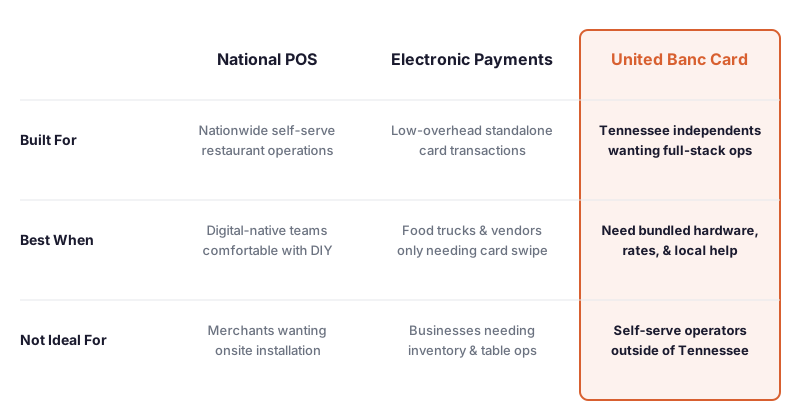
At-a-Glance: POS Systems, Electronic Payments, and United Banc Card of TN
| POS Systems for Restaurant & Retail | Electronic Payments | United Banc Card of TN | |
|---|---|---|---|
| Core purpose | Full operations management + payments | Card acceptance only | Local full-stack POS + processing + support |
| Pricing model | Monthly subscription per location | Per-transaction or terminal rental | Free hardware with processing agreement |
| Starting price | $0–$49/mo (Square); $89.95/mo (Clover) | $8–$25/mo terminal rental | $8/mo terminal rental; hardware free with processing |
| Free tier | Square POS free tier available | No monthly fee options available | 30-day trial available |
| Key feature | Order routing, KDS, inventory, loyalty | EMV, NFC, Apple/Google Pay acceptance | Onsite install, staff training, lifetime hardware warranty |
| AI/analytics features | Advanced reporting, labor/food cost tools | Basic transaction reporting | Deep analytics via Lavu, Korona, Retailcloud platforms |
| Ease of use | Moderate to steep (Toast); easy (Square) | Very easy; minimal training required | Onsite training included; staff-ready in 24–48 hours |
| Integration depth | Deep native ecosystems (Toast, Square) | Narrow; accounting export focus | Platform-dependent (Lavu, Clover, Korona ecosystems) |
| Support | Chat/phone support center; varies by tier | Email/chat; limited phone | 24/7 local Tennessee-based support; direct owner access |
| Best for | Multi-location restaurants needing full ops | Mobile vendors needing card acceptance only | Tennessee independents wanting local accountability + full stack |
Pricing as of mid-2025.
Next Steps
If your operation runs on order flow, inventory management, and staff coordination, a full POS platform is where to start: Square for ease and transparent pricing, Toast for deep restaurant workflows, Clover for hardware flexibility. If you only need to accept cards reliably, a standalone terminal or mobile reader keeps costs low and deployment fast.
If you're a Tennessee restaurant, retail, or hospitality operator who's tired of explaining your problem to a different call center agent every time – and you want a named local contact who handles the hardware, the software, the rates, and the installation in one call – United Banc Card of TN is the stronger option than either: free hardware with processing, a lifetime warranty, and a local expert who can be onsite within 48 hours. Call (615) 476-0255 or request a free quote at unitedbanccardoftn.com.
For Square and Clover pricing specifics, visit their respective pricing pages directly to see current tier details.
Frequently Asked Questions
What is the difference between a POS system and an electronic payment solution?
A full POS system manages complete restaurant or retail operations-orders, inventory, staff, kitchen routing, and payments together. Electronic payments handle only card acceptance: terminals or readers that process transactions without workflow or inventory layers. A restaurant with a kitchen team and table service needs a POS; a food truck that takes cash and cards needs only a payment reader. The core difference is scope: POS is an operating system for your business, while electronic payments are a single transaction layer.
Why would a restaurant choose a full POS system over just using a payment terminal?
Restaurants with table service, kitchen staff, and inventory need order routing to a Kitchen Display System, table management, split-bill handling, and real-time inventory tracking-capabilities no payment terminal provides. Toast's KDS integration, Square's course sequencing, and Clover's inventory APIs connect the payment transaction to the operational workflow that happens before and after. A payment terminal can process the final card swipe, but it won't coordinate orders from front-of-house to back-of-house or update your stock counts automatically.
What are the typical costs to set up a full restaurant POS versus a basic payment terminal?
Full restaurant POS platforms require both hardware and monthly software fees: Toast Essentials runs approximately $165/month plus $5,000–$15,000 in hardware with 2–3 year contracts; Clover ranges from $89.95–$129.85/month plus $849–$4,447 in hardware; Square Plus is $49/month plus equipment costs. A basic payment terminal costs $8–$25/month to rent or $299–$799 to purchase, with no monthly software fee. The upfront gap is substantial-a full POS setup can run $15,000 vs. $300–$800 for terminal hardware alone-but the operational benefits at higher volumes justify that investment.
Can a food truck or mobile vendor use a full POS system effectively?
Food trucks can technically use tablets running Square or Clover, but the full POS feature set-table mapping, KDS, multi-location inventory-adds unnecessary complexity and cost for businesses taking 10–20 orders per hour with no kitchen team. Mobile vendors benefit more from a lightweight payment reader like Square Reader or a mobile-optimized terminal that accepts cards anywhere without requiring menu setup, item tracking, or kitchen integration. For a food truck managing inventory manually and taking simple orders, a standalone payment solution reduces overhead and training burden significantly.
How do POS systems handle inventory differently from payment terminals?
Full POS platforms for retail track every SKU sold, trigger automated reorder alerts, and link purchase history to customer loyalty records in real time. Clover's inventory module and Retailcloud's omnichannel suite both update stock counts at the moment of transaction. Electronic payment terminals record only the transaction amount and card type-there is no inventory layer, no SKU tracking, and no automatic reorder capability. Retail businesses managing multiple product lines and stock levels need POS inventory integration; businesses selling a single service or product can rely on external inventory management or manual tracking.
Which POS platforms integrate best with delivery services like DoorDash and Uber Eats?
Toast has native integrations with DoorDash, Uber Eats, and other major delivery aggregators, pushing orders directly to the KDS without manual re-entry. Square's Plus plan ($49/month) supports delivery platform integrations through Square Marketplace partnerships, though setup requires additional configuration. Clover integrates through third-party apps in its marketplace but not natively with delivery platforms. Electronic payment terminals have no delivery integration-they only accept the final payment. For restaurants relying on delivery revenue, Toast's native integrations save time and reduce order entry errors, while Square offers broader flexibility if you work with multiple aggregators.
What makes United Banc Card of TN different from national POS vendors like Square and Clover?
United Banc Card of TN is a Tennessee-based local merchant services provider that bundles POS hardware, software, payment processing, onsite installation, staff training, and 24/7 local support under one relationship with a named owner. Rather than pushing a single proprietary POS, they match the right platform to your business: Lavu for restaurants, Korona for convenience stores, Retailcloud for omnichannel retail. They provide hardware free when paired with a merchant processing agreement, offer lifetime POS warranty coverage versus industry-standard 1-year warranties, and handle installation and training onsite within 24–48 hours. National vendors optimize for scale and self-serve efficiency; United Banc optimizes for local accountability and hands-on support.
When is onsite POS installation and training worth the extra time investment?
Onsite setup is valuable when transitioning from legacy systems, training non-technical staff, or configuring complex workflows like restaurant KDS routing or multi-location inventory management. United Banc Card of TN's 24–48 hour onsite setup and staff training eliminates the learning curve YouTube videos and email support create-your team goes live confident and competent. For digital-native owners signing up for Square or Clover online at midnight and deploying by noon, self-serve onboarding is faster. For independent restaurant operators coming off aging Micros systems or paper-based retail operations, hands-on local installation reduces risk of configuration errors and staff confusion.
How do processing fees compare between full POS platforms and standalone payment terminals?
Processing fees are separate from software subscription costs and apply to both categories. Full POS platforms typically charge 2.6–2.99% per in-person transaction plus per-device KDS fees; Square Plus adds per-location charges on top of per-transaction rates. Standalone payment terminals often use interchange-plus pricing, where merchants pay a fixed percentage markup (0.5–1.5%) plus interchange, or tiered pricing that varies by card type. The advertised POS software fee ($49–$165/month) is misleading-processing costs usually dwarf software costs for restaurants doing $50,000+/month in volume. A local processor like United Banc Card negotiates these rates by relationship rather than publishing fixed tiers, which often yields better margins for independent merchants.
What is the biggest limitation of electronic payment terminals for retail operations?
Electronic payment terminals accept cards but provide no inventory management, customer purchase history, or real-time stock tracking. A retail business selling 50+ SKUs cannot track reorder points, link repeat purchases to loyalty programs, or see which products drive margin-all critical for profitability. Square or Clover retail POS platforms integrate inventory tracking with every transaction, automatically flagging low stock and alerting owners to reorder. If you're managing a retail operation with multiple product lines and employees, a standalone payment terminal leaves you blind to your core operational metrics.
Who should consider United Banc Card of TN over national POS platforms?
Tennessee restaurant and retail operators frustrated with national call centers and wanting a local technician onsite within 48 hours should consider United Banc Card of TN-especially if they've experienced downtime during peak hours and received indifferent phone support. Convenience and liquor store retailers often feel neglected by Square and Toast's restaurant-first focus; United Banc offers Korona POS specifically for these verticals. Multi-location merchants seeking bundled processing plus business lending (merchant cash advances, SBA loans, equipment financing) under one relationship will find efficiency in a single local partnership. Independent operators skeptical of big-box promises and wanting transparent rate negotiations with a named contact are the core audience.
Is United Banc Card of TN available nationwide or only in Tennessee?
United Banc Card of TN primarily serves Tennessee markets including Nashville, Murfreesboro, Franklin, and surrounding areas with onsite local support as a core differentiator. While the company offers merchant services regionally, the local service advantage-same-state technicians, named owner accountability, 24/7 local support-does not extend nationally. If you operate across multiple states, national vendors like Square and Clover provide consistent service everywhere; if you're Tennessee-based and value local expertise and onsite support, United Banc is positioned to serve your market specifically.